Search The Forgotten Realms Lyceum

Showing posts with label Troy Denning. Show all posts

Monday, June 2, 2025

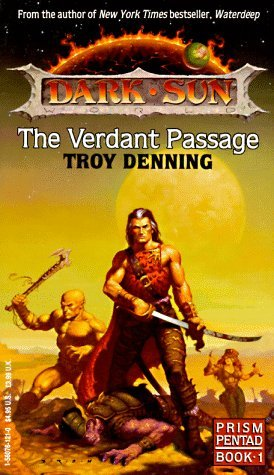
The Verdant Passage - My First Experience with Dark Sun

 In June of 2024, I read the 1991 novel The Verdant Passage by Troy Denning. I have read many of his novels set in the Forgotten Realms, but this was my first time reading anything in the Dark Sun campaign setting. Over the years I have explored these other D&D settings, such as Dragonlance and Greyhawk. Dark Sun is different from these, and the Forgotten Realms, for (as the name implies) the setting is rather dark.


The Verdant Passage is book one of The Prism Pentad, of which I have the first three. As of writing this, I have also read the second book. Denning was one of the key designers of the setting, which was blessed with artwork by Brom.


Dark Sun is a low magic dying earth setting, where sorcery has drained the world dry, like a much bigger version of the Forgotten Realms' Anauroch. The setting therefore relies psionic powers and it feels more sword & sorcery than the high magic of other D&D settings. There are also things like the insectoid thri-keen and 2 moons over Athas, the planet that give it some flavor.


In a dark city in the midst of desolation, named Tyr, a being named Kalak has ruled for a thousand years. But the tyrant is about to meet his end at the hands of three unlikelies. 


The story introduces the king and a Templar named Tithian. Tithian is a great character, serving as priest to the god-king that is frail and powerful all at once. Tithian is in an interesting predicament and will play an important role in the future of the realm.


Sadira is a nubile half-elf woman that is the least interesting. She has some free love ideas but besides that she is largely dull. Though her magic is interesting.


Agis was the childhood friend of Tithian. He’s almost the opposite of him, having the drive but not the greatest cunning, rather he is romantic and has humanistic values and intelligence in ways most others don’t. Rikus and Neeva are gladiators, slaves bred to fight. They are dangerous and hope for freedom. They often fight in the arena as a pair and are meant to breed together too. 


Then there is the very alien Gaj. It is very deadly but interested in understanding the characters readers should connect with easier. There are also dwarves, halflings, and elves, but all under a crimson sun. I also thought the divine magic of D&D was unique in this setting. Overall, it still feels like D&D fantasy over sword and sorcery, but darker than most settings. 


Overall the book felt consistent, I’ve seen some say the end fizzles or the beginning is the best but I think it’s a fun short D&D novel that does fine and manages to be more entertaining along the way than some other Denning novels I’ve read. 

--


You can track my current progress here.

Monday, October 21, 2024

Completed Series: The Cormyr Saga by Ed Greenwood, Jeff Grubb, and Troy Denning

 “And in this land I’ll proudly stand
Until my dying day, sir
For whate’er king o’er all command
I’ll still be a Cormyte brave, sir.”


The Cormyr Saga is a trilogy of novels written by three authors, Ed Greenwood, Jeff Grubb, and Troy Denning. It highlights the tumultuous last years of Azoun IV's reign of The Forest Kingdom as it faces a plethora of threats that could prove its doom. I read these all in January and February
2024. 


Corymr by Ed Greenwood and Jeff Grubb (1998) - Exceptional

Beyond the High Road by Troy Denning (1999) - Acceptable

Death of the Dragon by Ed Greenwood and Troy Denning (2000) - Good


Cormyr: A Novel is book one in the trilogy, and is written by two giants of Realmslore, the creator Greenwood and original overseer Grubb (who I'm used to seeing write with his wife, Kate Novak).


This is the origin of the most powerful nation in Faerun, Cormyr. It’s also my favorite nation in the Forgotten Realms, I’ve read several books set in it, by Ed Greenwood, Jeff Grubb and Kate Novak, Erin M. Evans, Mel Odom, Scott Ciencin and more. 


After the dedication and epigram, the book opens with a note about chronology. It mentions the naming of the years by Alaundo the Seer and also that Dale Reckoning is used in place of Cormyr Reckoning for the sake of the reader. 1 DR is -24 CR as the first Obarskyr king was crowned about a generation after the raising of the Standing Stone establishing the Dalelands. 


The prologue opens with the dragon Thauglor in the Forest Country on the hunt. It is -400 DR, about 1700-1800 years before most Forgotten Realms events. It is the Age of Humanity, but that race has only barely made its way to the Dalelands, and Sembia would not be founded for another thousand years. At this point, Jhaamdath has not yet fallen and neither has Netheril. Though the latter will fall within the century and the former will follow a century after that. Elminster would not be born for six hundred years.


Mention of duskwoods on the second page followed by phandar, silver barks, shadowtops, felsul, manyroots and laspar tells us this is Greenwood’s Forgotten Realms, as the fictional trees found in a large chunk of the Realms are hardly mentioned by other authors. 


Thauglor the Black hunts buffalo, nothing intelligent and so it’s not very enticing but we are shown the great wyrm’s dominion and lack of civilization, his standing alone. This in some way aligns the dragon with nature. This is expanded when a young wyrmling, a descendant of his, flies up to share the meal.


This is Kreston, “Spawn of Casarial out of Miranatol, grandchild of Hesior, blood of the mighty Thauglorimorgorus, the Black Doom.” And it is this Black Doom that is so ancient his scales are beginning to turn somewhat violet. 


But he may have found the start to his own doom, an elf is in the Forest Country, and where one elf is surely there will be more. 


This portion of the narrative largely follows Ondeth Obarskyr of Impiltur, but his name should tell you he will become important (for those unaware, Obarskyr is the royal family of Cormyr). He with his wife Suzara, and his sons Rhiiman and Faerlthann, and his brothers Andar and Villiam. They arrived via Marsember, apparently a port town at the time, and homestead in what will become Suzail. Ondeth is a good man, but can he prevent all strife with the local elves?


The story also coincides with the late second edition timeline of the Forgotten Realms. Chapter 1 is set in 1369 DR on the sunset of Azoun IV’s reign, and the vying for succession is getting heated. 


We catch up to Azoun IV hunting in the King’s Forest. He has a couple old compatriots and one young guard named Aunadar Bleth. The rest of the party is a mile away on the prowl, maybe for the legendary Ghost Stag that only the king may hunt.


Bleth himself is favored by Queen Filfaeril and the crown princess, Tanalasta. He doesn’t immediately become a suspicious character but isn’t openly disliked either. Though Tanalasta largely comes off as a child in a woman’s body, she’s just a tool for manipulation. Vangey, Royal Mage, is essentially the main character.


The two royal cousins at the start are Duke Bhereu Ammaeth of High Horn and Baron Thomdor Ammaeth of Arabel. I don’t see how one could have such a low rank, especially as being Warden of Eastern Marches. I feel he should be at least a Marchion which is the equivalent of a Marquis or Margrave and it’s just below Duke in rank, while Baron is very low in ranks of nobility. And being over the Easter Marches implies he is a Marchion, as "marches" is where the title comes from. 


Other characters include Iliphar Nelneuve, Lord of Scepters. He leads the elves going into the Forest Country and acts like he owns the place. He showcases a feud between dragons and elves that really put both sides as having good arguments. Neither is good nor evil, so much. The last couple sentences of his introduction connected with me more. 


Mistinarperadnacles, or Mist, from the novel Azure Bonds, makes a cameo as does Giogi Wyvernspur from that series and star of The Wyvern’s Spur. As do royal swords Symylazzar, Ansrivarr, Orbyn, etc. 


Alea, an elf, showcases the racial prejudices that crop up in the Realms. Baerauble Etharr is a supposed civilized man next to the barbaric humans the elves war against. He’s also an ancestor of Vangerdahast. There’s also Gantharla, Itharl, Sagrast, Amedahast, Thanderahast, Elvarin, Emthrara, et al.


When Alusair is introduced she is hunting swine-nosed orcs in the Stonelands. These orcs are guilty of raiding a caravan east of Eveningstar. She’s fierce and loyal. I really like her, she reminds me some of Raedra. I may need to seek out novels she stars in as she is not in this one as much as I'd like.


Also, we get some scripture for the church of Malar, the Beastlord. We see the sword Symylazarr. The lore bits Greenwood always deliveries!


We get to see this is far from Cormyr’s first crisis. Can a kingdom only last so long because of strong magics protecting it? This is a true epic, telling the founding of a nation and people and full of politics. A great ending with surprising developments. It’d work as a standalone too but does connect well with the next two.


This reminded me of the later politicking in Brimstone Angels series my Erin M. Evans. The grand scope and information it gives you in Cormyr makes this a good place to start too, though there are of course several others. It also has the best usage of Red Wizards I’ve seen yet. Overall, an Exceptional read.


“Key’anna de Cormyr” 

We guard this wooded land.


Beyond the High Road is by Troy Denning, the only one in the series with a single author and easily the weakest.


A Paladin of Torm is on the hunt for a criminal. This man has slaughtered many Purple Dragons and turns out it’s more of a monster, a vampire or maybe something worse. This Paladin is a member of the Sleeping Sword, a group of warrior nobles essentially in fugue and only woken when a prophecy concerning the doom of Cormyr needs to be addressed. 


After this encounter we are brought to heir-apparent, Princess Tanalasta. She’s working on getting married so she can produce an heir. She is almost thirty-six years old, and after the close call in the previous book, she is taking her birthright more seriously. 


It’s now 1370 DR, the following year of the Abraxis Affair from book one.


She’s changed much, a hint of this showing at the end of Cormyr. Now she is pursued by suitors and is much more capable of reading their intent. She must find someone sincerely hoping for the good of the realm and hopefully someone she does love or can. 


She bashed heads with Vangerdahast, who she has little patience for though he’s the most trustworthy servant of King Azoun and Queen Filfaeril. Particularly where the key suitor is concerned, Donnath, son of the duke who is of Warden of the East Marches.


She’s also turned to primary worship of Chauntea, goddess of harvest. This seems an odd choice for the royal family, and is met with disapproval by them. It does make sense as the land is facing blight. 


There is a great amount of Forest Kingdom nobility, even a brief appearance of Kay and Giogi Wyvernspur who played a pivotal role in the first book and the earlier The Wyvern’s Spur (though this isn’t necessary to read before Beyond the High Road). 


I’m not a huge fan of how Denning treats Vangey, it’s similar to how Karen Traviss treats Dr. Halsey in her Halo novels but not as bad. 


But the ghazneth is a very interesting and unique enemy. Also, the Sleeping Sword is awesome though we get little of it. There is also some understanding of the Realms and morality that other authors don’t grasp, such as a conversation on evil elves where it’s made clear not just drow can be evil. It’d be better if they had said not all drow were evil too, but still, it was nice. 


We also get a look at ancient elven language, which is a nice treat. Also more Cormyrean history. It’s also more sexual than most Forgotten Realms novels, even a sex ceremony of Chauntea called the Seed Ceremony for conception purposes shows up.


Not my favorite by Denning but not his worst. Some nice moments but I look forward to Greenwood having some of the reins in book 3. I enjoyed book 1 more. Also while the first can stand alone this feels like setup for book three. There is some fun mystery and good action too. It's Acceptable.


The final volume, Death of the Dragon, is explosive and conclusive.


This is a follow-up to book two.


This one starts with Alusair, the adventuring Princess of Cormyr, the second child of King Azoun IV and Queen Filfaeril. She is searching for Rowan Cormaeril as he is important to the heir to the throne. But where is Rowan?


She stumbles upon more ancient things dealing with elves and the ghazneth, terrifying creatures made after betraying Cormyr, including old King Boldovar the Mad and Suzara of which Suzail. 


Tanalasta is still in the north in danger and King Azoun goes to war. While Vangey is missing. The royal family goes through some changes and it’s sweet to see their love for each other during this difficult time. Tanalasta is also more likable than she was in book two and so is Vangey. This is probably some of Greenwood’s influence. Alaphondar is also present. 


Nalavarauthatoryl is an enemy that comes to light, the dragon in question and key to the plot and future of Cormyr. We see her home plan full of goblins that feed the Goblin War. 


Again it is somewhat sexual at times, or has nonchalant nudity the Realms is somewhat known for. But it’s also dark, somewhat melancholic and bittersweet. There is some great character development and things on display. Besides greed for power we have sacrifice and forgiveness. 


I very much enjoyed the ending of this one, though overall the first book is the best. Lots of changes bringing the Realms from 2e to 3e in this one, but only politically, not cosmologically as was the case in 1e to 2e. Overall this inspired my current campaign I've been running for nigh on a year, set during the same time period in eastern Cormyr. It's a GOOD series, at least give the first one a try.

--


You can track my current progress here.

Monday, January 22, 2024

Review: The Veiled Dragon by Troy Denning

 Hello, friends! Today I wanted to look at The Veiled Dragon by Troy Denning. This is a 1996 novel that is technically book twelve in The Harpers series but is really only a sequel to Denning's earlier Harper novel, The Parched Sea.

The story starts with our heroine, Ruha. She has left Anauroch and is now in the Dragonmere aboard a caravel piloted by Captain Fowler, a half-orc with the classic piggish snout. After her adventures in the first book in her homeland she is now in the employ of the Harpers herself. She is assigned by Storm Silverhand to get to Pros. She has had one previous assignment in Voonlar. We learn she botched that job and a hundred people ended up in slavery as a result.

The sea trip quickly turns deadly as a dragon is spotted. The cover will give some of this away, but it is honestly a very cool introduction. I even did my own take on it in a short story of my own.

The rest of the story involves the Shou. Like the Bedine, these are analogous to a real-world group. I don't think these would be written today but likely were written to sell Oriental Adventures but are obviously orientalist in nature. While I do not care for such an obvious real-world analog in Faerun, the Shou themselves are not deemed lesser but different. There is an odd dialect that the Shou speak that has aged poorly.

Essentially the novel starts great but quickly descends just by the nature of what is being explored. It has some exciting moments and good action, and the descriptions that Denning conjures for a desert-dweller experiencing the sea are executed well. For example, the waves are described as dunes. But after reading this Mediocre book I was looking for better Realms novels.

--


You can track my current progress here.


Monday, November 6, 2023

Review: The Parched Sea by Troy Denning

In 1991 Troy Denning introduced the monstrous series of The Harpers. They're largely standalone or have internal arcs, so you have no need to read 1-16 like it is The Wheel of Time. The first of these is The Parched Sea which introduces Ruha, whom Denning would use in more of his Forgotten Realms novels, including The Parched Sea's sequel, The Veiled Dragon, book five of the Avatar series, Crucible: The Trial of Cyric the Mad, as well as in The Return of the Archwizards trilogy. You can listen to my thoughts here.

Ruha is newly married and is adjusting to her life with a new tribe, the Qahtan of the Bedine in Anauroch desert. She keeps secret her portentous visions so the Qahtan will not think she is a witch. In reality she does know some magic which she learned from a witch who raised her for some of her childhood. 

Her call to adventure comes when her new husband, Ajaman, is given night guard duty. Disaster strikes the Qahtan, and Ruha finds her life upheaved. 

Lander, a Harper from Sembia, is in Anauroch to follow the moves of the Zhentarim. He will become important to this stage of Ruha's life. The year is 1360 DR, a couple years after the Time of Troubles. Cyric is presently God of three domains, and his Bedine aspect is Naser. 

The novel itself is pretty predictable. The Bedines are obviously inspired by the Bedouins. They don’t like magic since greedy magic users are what made the desert in the first place, at least in part (see the history of Netheril). The big theme is prejudice and finding belonging while fighting foreign interlopers. 

The desert setting is cool, I don’t read too many in such a biome. I wish Ruha was more of the main character over Lander, she was much more interesting, and Lander takes some of the attention away from her.

There is some romance here and is not the worst thing I have read by Denning. If I were you, I might skip this novel since there are better ones worth reading unless something here makes you think you would enjoy it or you are a completionist like I am. Regardless, my next review will be for the sequel, The Veiled Dragon.

--


You can track my current progress here.


Monday, January 16, 2023

Review: Honest and True by Troy Denning

Honest and True is a short story found in Dragon Magazine 245 from March 1998. It is a tie-in to Crucible: The Trial of Cyric the Mad, also by Denning and released the month prior as the fifth and final volume in the Avatar Saga. The story follows Malik el Sami, Chosen of Cyric, as he still tries to do his god’s bidding shortly after the events of the novel. 

The story can be found from pages 57-64, with story artwork by Matt Wilson on page 56. 

The story is in first person like the novel, but we learn that Malik still has the truth spell put in him by Mystra. This leads to a great narration that is inaccurate to many but true to Malik’s view of the world. Such as calling the Harper’s “a band of meddling fools” and Deneir “the Prattler”. Like in The Sentinel, Malik is the Seraph of Lies, a special servant of Cyric’s.

He is in Waterdeep attempting to get his story published, which is of course proving difficult. This is exasperated when the Harper Ruha, the Bedine Witch, shows up. 

This story is very gripping and the perfect length. I enjoyed being back in a story from Malik’s point-of-view, and it makes an Exceptional short story for fans of book five.

I believe there is at least one more tie-in story to the Avatar Saga in Realms of Valor

--


You can track my current progress here.

Monday, January 2, 2023

Completed Series: The Avatar Saga

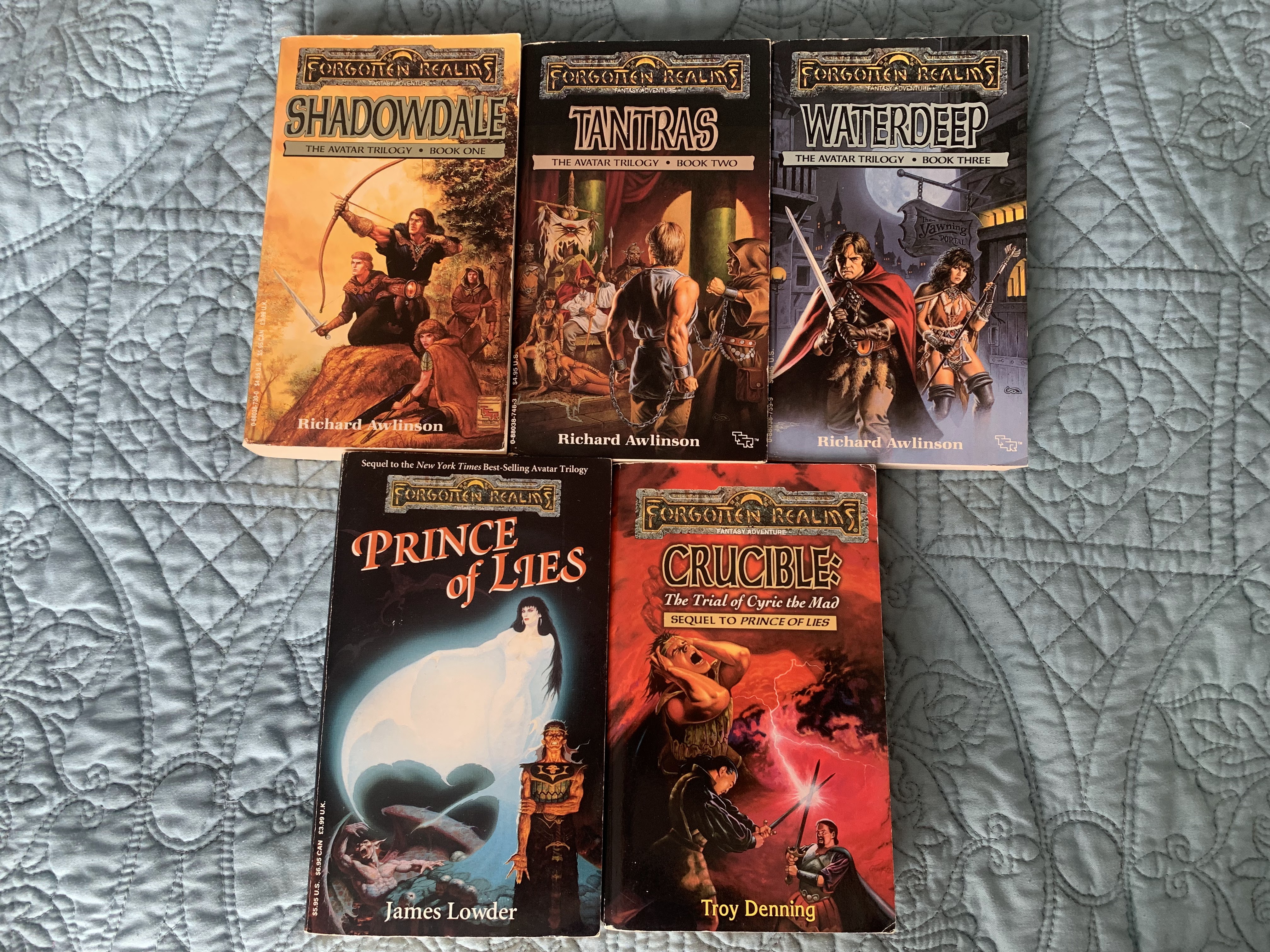
The Avatar Saga (or Series) is five novels and written by three different authors. It was originally a trilogy published under the nom de plume of Richard Awlinson, but was later expanded upon. The original trilogy deals with the Time of Troubles in 1358 DR, and the next two finish out the cosmological changes over the next decade. For those unaware, the Time of Troubles deals with the gods being cast down to Faerun as mortals by the Overgod, Ao. This is key to the plot of the books.

I read Shadowdale in December of 2021, and did a standalone review of that, which can be read here. I finished the series in May of 2022. I have the original versions of each book, but they were later reprinted to match.

Shadowdale by Scott Ciencin (1989) - Mediocre

Tantras by Scott Ciencin (1989) - Acceptable

Waterdeep by Troy Denning (1989) - Good

Prince of Lies by James Lowder (1993) - Exceptional

Crucible: The Trial of Cyric the Mad by Troy Denning (1998) - Exceptional

This review will have some larger Realms spoilers for the last two books, since they deal with decades old cosmological changes. Anyone familiar with 2e-5e Forgotten Realms will not be surprised by the status of certain gods. I will avoid these for the first three.

I ended up really enjoying this series. It is a little cheesy at times, and I knew some of the end going in, but each book was better than the last, which really impressed me.

Shadowdale starts with the events that would bring the Forgotten Realms from first edition to second edition. The Tablets of Fate have been stolen, and since no one steps forth as guilty, Lord Ao casts all gods down to Toril. They must walk in mortal avatar form, and are therefore vulnerable to die, permanently. The only god left with his divinity is Helm, who guards the way to the planes.

reprint cover

With the deities casting out, we first see Mystra, goddess of magic, try to access the Weave--from which all magic of the Art comes--and she fails. Then Bane, god of hate, terror, and tyrannical oppression, lands in Zhentil Keep and takes an avatar as he sets about his malevolent plan to reacquire the Tablets of Fate. We learn that it was him and Myrkul, God of Death who hid them in the first place.

Near the city of Arabel in Cormyr, the mage Midnight awakens to find things not as she left them, most notably she has a strange amulet around her neck. Her and three other heroes find themselves in the midst of the power struggle of the deities and their minions. 

One of the others is Kelemvor, a noble-born sellsword warrior also in Arabel during the events of the Arrival. He is a little moody and not much of a people person, but still honorable and pretty average in his temperament besides his glaring misogyny, which is kinda out of place in the Forgotten Realms. He is acquainted with Cyric as they recently went after the artifact The Ring of Winter. He is approached by a starving waif on the streets who seems to have a quest in a mind for him. 

Cyric is a thief turned mercenary. Honestly my favorite character, which is funny if you know what becomes of him. One thing I found really interesting was that Cyric was born in Zhentil Keep but was adopted by wealthy Sembians and lived there until he was a teenager.

Then we have Adon, a Cleric of Sune Firehair, goddess of Beauty. He is familiar with Cyric and Kelemvor as he was also used by Lady Lord Myrmeen Lhal, ruler of Arabel to bring down a conspiracy recently. Adon is certainly vain and a little arrogant and foolish.

We learn that the only magic that works in divine magic of clerics that are within a mile of their deity's avatar. Arcane magic is dangerous and inconsistent. We also get quite a number of vague descriptions of the gods and goddesses of the Realms. Those unfamiliar with the pantheon may be a bit lost.

There is a bit of romance sprinkled into this travel log. The group's goal is to go from Arabel to Shadowdale to meet with Elminster, the chosen of Mystra. Things escalate along the way and things become quite serious. 

This story is a little slow paced, but the overall descriptions and style of Ciencin makes for great imagery. This book does end on quite an unexpected cliffhanger.


Tantras
starts where book one ended. As the title tells us, this adventure leads the heroes to Tantras in The Vast. The city has become the holy seat of Torm, and no longer experiences a day/night cycle, for it is eternally bright. This story still has Bane as the main villain, but Cyric's and Kelemvor's paths start to diverge from their route in the first book, and head in directions that Realms fans may be more familiar with. Adon's arc is also very interesting, as it deals with the matter of faith. Midnight is the least interesting here, and it seemed as if Ciencin might have had a hard time writing a woman character.

There is great action here, including an explosive confrontation between two avatars. There is also a trial for two people falsely accused of murder. Some like that, and others do not. I thought it was well done. 

Waterdeep explodes where book two ended. This one takes our heroes from the Heartlands to the Sword Coast, to the City of Splendors, Waterdeep. This is the first novel in the series written by Troy Denning, which was. It also pushed the gods Bhaal, god of murder, and Myrkul into the forefront. These two, along with Bane, make up the trifecta known today as the Dead Three. 


This one really feels like the climax, and it originally was. We experience dead fortresses, undead, great and fell magic from Cormyr to Waterdeep. The cosmology shifts even more here, as dead gods are replaced with new ones. The character arcs are even better, as Denning handle's Midnight's character better. It was quite a ride and I look back on the experience of reading these exploits in the Time of Troubles fondly. 

Prince of Lies gets us into some cosmological spoilers. This story is set around Zhentil Keep and the writing of Cyric's holy text, the Cyrinishad. He has taken on the portfolios of murder, death, and strife with the demise of the Dead Three. We have Mystra (Midnight)  vying to stop Cyric from magically gaining worshippers. We also have characters, such as Fzoul Chembryl, who misses Bane. And the scribe Rinda is charged with writing the Cyrinishad. We also have the more tragic person of Gwydion, who becomes more important in the last book. As a fan of the Realms, I knew Kelemvor was not in his position of God of the Dead by the end of Waterdeep, this rectifies that.


Yet again this novel proved to be even better than the last. This was the first time I had read anything by Lowder, but I look forward to more of his Realms works.

Crucible: The Trial of Cyric the Mad deals with Mystra and Kelemvor seeking to once again prevent Cyric from finding the Cyrinishad. Adon's role as a priest is one very different from his earlier days in Shadowdale. What makes this story all the better is the point of view it is told to us. This story is from the intra-diegetic narrator of the Calimshite Malik el Sami, a worshipper of Cyric some readers may recognize from The Sentinel. This means everything is unreliable to a degree, though not inaccurate as far as the events go. Some do not like this narration, but I enjoyed it tremendously.

We also have the character Ruha from Denning's novels The Parched Sea and The Veiled Dragon. I have not read them yet, but fans of those may enjoy this sequel of sorts. It also explores even more places, like Candlekeep.


Overall we get quite a tour of the Realms, from Arabel, to Shadowdale, to Scardale, to The Vast, to High Horn, to Dragonspear, to Waterdeep, to Zhentil Keep, to Candlekeep. The vast array of characters is handled quite well by three authors and proves entertaining from the fist to last, making this an Exceptional reading experience.

--


You can track my current progress here.