Search The Forgotten Realms Lyceum

Showing posts with label Experiencing Other Settings. Show all posts

Monday, June 16, 2025

The first D&D Anthology - Dragontales edited by Kim Mohan

If you have stuck around for awhile, you may remember I reviewed the first novel for Dungeons & Dragons, Quag Keep, some years ago. Before Quag Keep there was only one other story officially tied to D&D, The Gnome Cache by Garrison Ernst (a nom de plume for Gary Gygax). It was serialized in the first issues of The Dragon, and released to the point it was a novella. In reality, it was a complete novel but never fully published. I'm not sure why. That was 1976. In 1978 Quag Keep released, and in 1980 the world received the third piece of D&D fiction.


That is Dragontales, ten stories not attached to any official settings, edited by Kim Mohan, who was working for Dragon Magazine but was not quite Editor-in-Chief yet. I recently read this and spoke about it on my Liam's Lyceum channel, so can watch/listen here if you would like.

The dimensions of this anthology are not like the mass market paperbacks of the lines for Dragonlance and Forgotten Realms that would come in later years. It actually is a magazine, though of heftier paper than most.

Here are the stories.

“The Wizards are Dying” by John L. Jenkins. This has an exciting start, a wizard faces haywire magic and warns his servant Grimsley the gnome of such danger who then barely escapes. We then meet fellows in a tavern discussing this immolation. These are Deihm, a cleric of the Brotherhood, R’kan a dwarf, and Faendril an elf wizard from Llum. It feels very D&D. Maybe an early stab at the success of things like The Sword of Shannara.

The story is rather straightforward: fight into a lich’s lair. It’s also one of the longest. There is a scholar, a girl with the generic fantasy name of Arya, manticores, and a classic party of adventurers. The worldbuilding feels like many a generic D&D world, but isn’t one I’m familiar with.

“Dragon’s Fosterling” by Ruby S. W. Jung. This one is pretty interesting. Asgara is the daughter of a count and one day she gets taken by a dragon. They have an interesting relationship, he teaches her some useful things but he’s pretty wicked still, killing the men that come to rescue her. It’s kinda boring to start, besides that Asgara speaks more like a teenage girl from the 80s with colloquialisms and slang. The end really amps up and I quite liked it. While a bit silly it’s pretty feminist. This one feels less strictly tied to game mechanics of DnD, Jung like the author before her doesn’t seem to have published anything else. A nice reference to the Saga of the Volsungs and the legend of Sigurd.

The third story is “Out of the Eons” by Gardner F. Fox, known for his comics and Kothar and Kyrik sword & sorcery stories. This is a story of Niall of the Far Travels who appeared in several issues of Dragon Magazine. Niall in this one is expanding his wine cellar when he goes through his wall he finds another wall and breaks through that as well. This inadvertently unleashes a sealed green spirit thing known as Adonair. The power of a goddess that is his lover protects him. A good clip, with godly things. Feels prettygeneric but not bad. 

Fourth is “Sir George” by Carl Parlagreco. I thought this might be somehow about a dragon slaying Saint George. Instead, George is the dragon and this is comic. Like Shrek or Myth Adventures. When a knight comes calling for George’s head to win a maiden in matrimony, things go a different route. It’s rather short too and my favorite of the first four. 

Fifth is “Black Lotus Moon” by Tom Moldvay, before his famous Moldvay Basic was released in 1981. In Biaazan, Tamara awakes with the man she spent the night with. She makes a swift acrobatic escape as the city watch bangs on the door, presumably looking for her, as the naked man feigns sleep. She finds out from her fellow thief Saris that the thieves guild and mayor have had enough to her, and instead to trap her and see her hang. We also are introduced to a Conan like Barbarian fur diaper man, Arngrim. And the sorcerer Gorilon, who dreams once a month under the haze of black lotus. Essentially, we’re gathering typical sword & sorcery protagonists to form a D&D party. A longer story, and nicer than the first story which also has a party of characters. While not great literature, I enjoyed it, and the ending was nice. It is another of my favorites in the anthology.

“Honor Among Thieves” by Roger Moore is about two thieves who make a short-lived pact. Pretty short and straightforward, I appreciated that. 

“Ice Dream” by David F. Nalle is 7th and shortest. It’s about a young shepherd being inspired by a traveling skald and it not quite going as we like to think adventure will. Similar to the beginning of Spellfire by Ed Greenwood.

“In the Darkness, Hunting” by Janrae Frank. This follows a woman who lives as a warrior and man among the nomads. She is an exile from her own people who have some inherent power that seems magical. The story starts with a chief for which she acts as war-leader, he wants to make her his woman, even though they’re sworn brothers in arms. She refuses, as among the nomads she would have quite a different life if they knew she was a woman. He then tries to force himself upon her. Easily the most interesting of the batch! This character also appeared in other anthologies, the first being in Amazons! from 1979.

“Just Call Me Albert” by Martin Mundt is another humous one, though told in first person. I don't have much to say on this one.

And last and tenth is “Birth of a Wizard” by Marie Desjardin. This is about a great wizard from a village returning home and the lack of welcome he receives. It really gets into thought-provoking aspects of power and manhood that I was not expecting. Another of the standouts!

Throughout there are also illustrations by James Holloway, M. Kay, Peter Laird, etc. Each story has several by a new artist for each. Some are not credited so blatantly so I'm unsure who all ten were, but the art is quite good!

Overall, the anthology has some good and mediocre stories, as I have come to expect from magazines and anthologies. But as a piece of history, it is very important. We have no orcs; it feels like a mix of the sword & sorcery that dominated fantasy fiction in the 1970s and the heroic fantasy flavor D&D established with later fiction. It is the third publication, and with ten stories increased the fiction of 2 stories to 12! Maybe find a copy and enjoy it yourself?
--

You can track my current progress here.

Monday, June 2, 2025

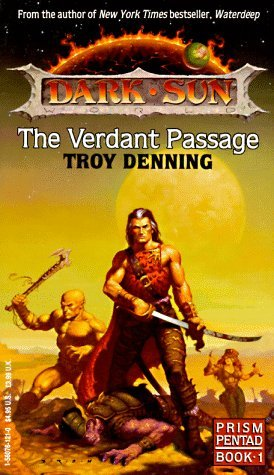
The Verdant Passage - My First Experience with Dark Sun

 In June of 2024, I read the 1991 novel The Verdant Passage by Troy Denning. I have read many of his novels set in the Forgotten Realms, but this was my first time reading anything in the Dark Sun campaign setting. Over the years I have explored these other D&D settings, such as Dragonlance and Greyhawk. Dark Sun is different from these, and the Forgotten Realms, for (as the name implies) the setting is rather dark.


The Verdant Passage is book one of The Prism Pentad, of which I have the first three. As of writing this, I have also read the second book. Denning was one of the key designers of the setting, which was blessed with artwork by Brom.


Dark Sun is a low magic dying earth setting, where sorcery has drained the world dry, like a much bigger version of the Forgotten Realms' Anauroch. The setting therefore relies psionic powers and it feels more sword & sorcery than the high magic of other D&D settings. There are also things like the insectoid thri-keen and 2 moons over Athas, the planet that give it some flavor.


In a dark city in the midst of desolation, named Tyr, a being named Kalak has ruled for a thousand years. But the tyrant is about to meet his end at the hands of three unlikelies. 


The story introduces the king and a Templar named Tithian. Tithian is a great character, serving as priest to the god-king that is frail and powerful all at once. Tithian is in an interesting predicament and will play an important role in the future of the realm.


Sadira is a nubile half-elf woman that is the least interesting. She has some free love ideas but besides that she is largely dull. Though her magic is interesting.


Agis was the childhood friend of Tithian. He’s almost the opposite of him, having the drive but not the greatest cunning, rather he is romantic and has humanistic values and intelligence in ways most others don’t. Rikus and Neeva are gladiators, slaves bred to fight. They are dangerous and hope for freedom. They often fight in the arena as a pair and are meant to breed together too. 


Then there is the very alien Gaj. It is very deadly but interested in understanding the characters readers should connect with easier. There are also dwarves, halflings, and elves, but all under a crimson sun. I also thought the divine magic of D&D was unique in this setting. Overall, it still feels like D&D fantasy over sword and sorcery, but darker than most settings. 


Overall the book felt consistent, I’ve seen some say the end fizzles or the beginning is the best but I think it’s a fun short D&D novel that does fine and manages to be more entertaining along the way than some other Denning novels I’ve read. 

--


You can track my current progress here.

Friday, July 16, 2021

Saga of Old City - My First Experience with Greyhawk

Saga of Old City was the first official novel for the Greyhawk setting. Other works, such as Quag Keep, had been set in an early version of the Greyhawk world. Gary Gygax, who created the World of Greyhawk and wrote Saga of Old City, decided to write the Gord the Rogue novels, of which Saga of Old City is the first, after the success of Weis and Hickman’s Dragonlance books showcasing the Dragonlance setting. 

Original cover by Clyde Caldwell
Young Gord the Gutless is our protagonist. He is poor and well established in pauperhood when we meet him. He has two coins, and they are not even copper, just iron. The start is reminiscent of other tales I’ve read of young orphans that steal and live in the streets, barely surviving and not even truly living. I was surprised how much Gygax’s prose was actually fine, I was expecting worse. 

From the streets, to jail, to the hands of the Beggarmaster, Gord goes swiftly. From the first page you know this is not a kids book. Dragonlance was pretty gentle, and maybe could pass for younger audiences, though it was definitely adult as well, comparatively Saga of Old City is gruesome and harsh; though not gross or disturbing. It’s definitely a coming of age to start, rather than a grand epic.

While I found Dragonlance more epic than your average Forgotten Realms tale, The World of Grehawk is less epic. It is essentially a Sword & Sorcery setting. It's rather low in fantasy, and full of decaying civilization of humanity. One example I think illustrates
this well is that the Thieves Guild of Greyhawk is a legal venture, assuming no one gets caught and pays the tithe from stolen coin and goods to the City Council.

Gord’s coming of age somewhat reminds me of Elminster’s, though it’s really just reminiscent of the trope in general. Chapters often skip a few years and shortly we have a young adult Gord getting into trouble. Don't worry, more than half of the story Gord is an adult.

It was great fun getting to explore a little of the Flanaess, basically the Faerûn equivalent being a portion of the continent of Oerik. We experience the world through the eyes of Gord who is seeing the places for the first time. Our character Gord is exactly as described: a rogue. He’s a thief, though not really evil, he serves himself. The plot kind of follows this random going-ons of his life, which is to say its all over the place.

The rogues in this are awesome, and I particularly love their impersonation skills. It’s nice because they just need to execute the act extremely well, and don’t need to bypass a ton of magic as there is low amounts of magic and even lowish amounts of people not human. 

2008 republished version

We do have some other characters in this, my favorites being Chert and Gellor. And while relative a story of human affairs, we do see a sea serpent, a demon, and a wolfwere.

When a large group fight breaks out near the end of the book, you really can see Gygax’s wargaming experience come through in stratagem and all the particular names for weapons of all sorts, along with the specific types of armor being worn. 

Overall, this is such a fun adventure of one small thief from Old City. The story is often told in such a way that the narrator tells of the next leg of the journey at the start of a chapter before then describing how Gord got there, and then continuing with what came after he was in the predicament. It is also extremely 1e AD&D with thief ranks, bards and what not. 

“A bard has something to do with druidical studies?” 

The last couple chapters really bring the story full circle and it ends very nicely. While the plot is kind of a mystery with this novel, I do believe some things seen here will show up for the rest of the series of Gord the Rogue. It was a fun ride, and I’d recommend just going with it, let Gord take you on the adventures of his young life. There are six more books after this one and I do plan on reading them all at some point.

--


You can track my current progress here.

Friday, July 9, 2021

Dragons of Autumn Twilight - My First Experience with Dragonlance


Dragons of Autumn Twilight is likely the most popular piece of Dungeons & Dragons literary fiction out there, even more so than The Crystal Shard. It is a classic novel published in 1984 by TSR, written in such a way to introduce the new setting by authors Margaret Weis and Tracy Hickman. In short, this story was very entertaining, and I am excited to continue. It was also very different than Realms' novels: more heroic, more catastrophic, more derivative of Tolkien, and so forth.


The book is divided into two parts called “books”. The first part introduces a group of friends coming back together after five years apart. They already all know each other except for a duo introduced early on in the tree top town of Solace.


A little slow at first, it always held promise to be an interesting story. The writing itself is good, and the worldbuilding is set up very nicely, giving us a feeling of a lost state for the world, where the gods are silent after a global catastrophe. The final chapters of part one had amazing endings where cities fell, gods spoke, and people were reborn. This was a grand journey, from point a to b to c, I was excited to dive right into the second part of the book.


The second “book” starts off similarly to the first, a sort of echo, which was fun. The story takes an interesting turn and we also get a couple more members added to the party, both of whom are awesome for different reasons. The intrigue that is introduced was also really fun to read since the limited views inside the characters’ heads made it difficult to guess. The plethora of characters makes it even tougher. That is one thing I liked, so many people in the party. I also forgot some on occasion. At its largest size the party has as many as twelve people! Fizban intrigued me the most, and Tanis was probably my favorite, along with Goldmoon.


I appreciated that the enemy was unique compared to typical D&D fare. Plus the gully dwarves were a nice and cute variation on the stout folk.


It was odd not taking many notes, and not being able to make connections to larger lore (not that it’s not there, I just don’t know it). Most of my notes were ideas for my own personal D&D campaigns. I’m also more interested now in Dragonlance as a setting than I have been before. I find the history of 300 years before the events of the book fascinating and those who know me know that I am a sucker for such lore and history: I need to learn more! I have question, the least of which is who is that old man?


After reading this, I definitely plan to read the rest of the trilogy, and likely some more Dragonlance novels, especially the ones that are in series with a Forgotten Realms novels. I also think I will share other D&D books I read, though I’m not going to read and rate all like I am for Forgotten Realms. I will keep track of this reading on the spreadsheet, so make sure to keep an eye out.


Have you read the Dragonlance books? How many have you read? 

--


You can track my current progress here.