Search The Forgotten Realms Lyceum
Monday, December 19, 2022
Genesis: The First Stories of the Forgotten Realms
Monday, December 6, 2021
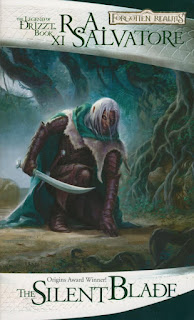
Review: The Silent Blade by R.A. Salvatore
The Silent Blade is a 1998 novel by RA Salvatore and Book eleven in the Legend of Drizzt and book one in the Path of Darkness series. This of course takes place in the world of Forgotten Realms.it takes place in the year 1364 of Dale Reckoning, for those curious that’s about 130 years before the present fifth edition timeline.
This will of course have some spoilers for the first ten books, beware. Read my thoughts on The Dark Elf Trilogy (books 1-3), The Icewind Dale Trilogy (books 4-6), and Legacy of the Drow (books 7-10). This review also has a video counterpart that can be watched here: https://youtu.be/W-1MnGOCzHM
It was nice having The Companions of the Hall back together even if their reunion in Passage to Dawn was lackluster. They of course start off at Icewind Dale and are leaving to bring Crenshinibon, the evil magical artificer commonly called The Crystal Shard, the south to Erlkazar to Spirit Soaring, temple to Deneir, in the mountains
Wulfgar is suffering, tormented by thoughts of Errtu in his nightmares. He’s no longer empathetic and his friends try to get him to feel again.
Entreri is back, he thankfully wasn’t present in the previous book, and I’m still of the opinion he should have died several books ago, but I digress. Entreri has returned to Calimport thousands of leagues to the south of Ten Towns in Icewind Dale, the furthest part of the Sword Coast still on it. These storylines. Initially don’t seem connected, besides the characters past connections. They do start connecting about half way through.
Part one sets up the Compnions storyline and Entreri’s, and honestly there was little combat in part one, and it was hardly drawn out 8 was really enjoying this, reminded me of the earlier Drizzt books. Wulfgars torment is deep, and it seems even friends or the old thrill of battle won’t dissipate his demons.
Part two brings Wulfgar more to the forefront, and his second encounter with a tribe of Uthgardt, the Sky Ponies, last seen in Streams of Silver was a greater view of the Companions past but also a larger view of the Forgotten Realms I often feel Salvatore misses in his works, seemingly forgetting them.
Jaraxle does make an appearance as well, a welcome one with his typical bravado and his webs of intrigue. Of the drow of Menzoberranzan, he is by far the most nuanced and interesting to read about. Though admittedly the guilds in Calimport sort of play the part of the warring houses of the drow city in this book. I much preferred this than the destructive and chaotic drow house wars which were a huge chunk of their society while the guild wars are just a piece.
Cadderly is mentioned several times, but doesn’t actually make an appearance here. While he does appear briefly in Passage to Dawn, for those unaware, Salvatore wrote The Cleric Quintet that introduces the priest of Deneir and his friends.
This book also amps up the sexual content, but not in a gross amount. It felt more adult rather than the juvenile feeling lots of the other Drizzt books had.
I finished Pssage to Dawn all the way back in August of 2020, I needed a big break from Drizzt and that break helped a lot. I enjoyed this one throughly though my pace wasn’t the best. I’d say it’s Exceptional, considering how the other Drizzt books have gone.
Monday, August 30, 2021
Review: The Reaver by Richard Lee Byers
The Reaver is a standalone book by Richard Lee Byers set in the Forgotten Realms during the events of The Sundering, when the cosmology got smacked around and gods were reborn and many changes brought by the Spellplague were brought back.
The Reaver is technically book four of The Sundering book series, but they’re all effectively standalone, though one character from The Reaver makes a cameo in the fifth book, The Sentinel by Troy Denning. And technically Stedd first appeared in book 3, The Adversary, but that was just a small introduction to him. The whole Sundering series is one of the few Forgotten Realms books you’ll find at Barnes and Noble these days.
The Reaver introduces us to some pirates of the Sea of Fallen Stars somewhere near the city of Teziir on the Dragon Coast. The Inner Sea has been wracked with endless storms in this time of upheaval. Our main characters are Anton Marivaldi who is a “renowned reaver with a insatiable thirst for bounty who, when it comes to a choice between two evils, always chooses the one he’s never tried” as the back of the book tells us. He is originally from Turmish
“When the tempest is born,
As Storm-tossed waters rise uncaring,
The promised hope still shines.
And the Reaver beholds
The Dawn-born chosen’s gaze,
Transforming the darkness into light”
So prophesied Elliandreth of Orishaar in the days of the First Sundering aeons before.
Evendur Highcastle, is an undead pirate captain, and chosen of Umberlee, who is the Queen of the Depths, evil sea goddess often fittingly called The Bitch Queen, funnily enough, who is after a perpetual tempest to cover the seas.
“[V]ying with high castle for the hearts and minds of the people is Stedd Whitehorn, a little boy and the chosen of a god thought lost to time: Lathander, the Morninglord”, the god of the Dawn.
Umara Ankhlab is a red wizard of Thay, in service to a vampire and sent as sent by the undead ruler of Thay, the lich Szass Tam.
The year is 1486 DR, so just a few years before most fifth edition Dungeons & Dragons adventures. Byers really makes the setting come to life, and it was interesting following someone of a more wicked bend. When finally getting a grasp of the situation in chapter one, Byers throws a wrench in.
We have pirates, vampires, chosen of the gods (alive and dead), sea monsters, gangs, and celestials,
Byers writing is nice though often over my head, he utilizes many words I’ve never heard before, in all his works. These words aren’t literary or archaic generally either, just very particular.
An interesting relationship develops in the book, one I wasn’t expecting. I always appreciate an unlikely friendship. While the story itself is good I was largely not drawn in and left disappointed by that. I found it Acceptable. I leave it up to you to decide if you may like it.
Monday, August 9, 2021
Review: Reunification (Body & Soul) by Jeff Grubb
Jeff Grubb is known for many contributions to Dungeons & Dragons, among the plethora of products he wrote was the Forgotten Realms comic line of the late 80s and early 90s. Years after finishing the comic series he wrote a short story that ties into it, that is Reunification (Body & Soul) from Dragon Magazine issue 247 of May 1998. It can be found on pages 63-71. If you want a glimpse of the characters as they appear in the comic line I reviewed the first story arc here.
There is another short story that also ties into Dragon Magazine 260 from June 1999. The story there, The Honor of Two Swords, was written by Grubb’s wife, and ofttimes writing companion, Kate Novak. I will be reviewing this later.
![]() |
| Story art by Rags Morales |
Vartan hai Sylvar, gold elf cleric of Labelas Enoreth, is in his god’s palace in Arvandor. He is acting like a sneak-thief to gain access a magical item so he can check on his old friends from the Halruaan caravel, Realms Master. Their old leader, the magic-user, Omen, is withering with disease brought in by a curse. He hopes to avoid his demise by magical means.
The party is on some unnamed island in the Sea of Fallen Stars, where an extravagant setup is being tested, to see if Omen can transfer his soul to a brass golem. He has tried every other option available to him. This goal takes them on a psychic journey.
This is after Jeff Grubb left TSR, but he had been going contract work still, mostly on Jakandor. It was great seeing a story in classic First Edition style (released in late 2e times), where gods interact with the people of Toril. While not a super meaningful story to me, since I haven’t read all the comics, it does leave some possibilities open. I’ll see what the next story holds, but maybe some crew of the Realms Master will appear in my own Games. The story is Good.
Friday, July 23, 2021
Review: The Godborn by Paul S. Kemp
The Godborn is the second book of The Sundering, the cosmological, world shaking series that brought Realms lore from fourth edition to fifth edition. It is also the final iteration of The Legend of Erevis Cale (I may have made that up), being a sequel to the Twilight War Trilogy. This is my fourth review for The Sundering, and you can read my thoughts for the others at these links: The Adversary, The Sentinel, The Herald.
The only two I have yet to read now are the first and fourth in the series. The Companions is also the 30th novel in the Legend of Drizzt; I have only read the first ten so far. The Reaver I will read soon.
Naturally, being a sequel to the previous Erevis Cales series, do expect spoilers if you have not read them. This book does work as a stand-alone, but I highly recommend reading the previous books beforehand.
“When the shadows descend,
In Hell-sworn covenant unswerving
The blighted brothers hunt,
And the godborn appears,
In rose-blessed abbey reared,
Arising to loose the godly spark.”
- Excerpt of a prophecy by Elliandreth of Orishaar
The prologue takes us to 1450 DR, Varra has been transported through time seventy years. She finds that her previously flat belly is now bulging with a presently due baby. She is found by warriors of Amaunator/Lathander who take her to the local abbey where her son, Vasen is born, destined to be a shadow in the light. I really enjoyed this prologue, and while not his best, Kemp is a master of drawing the reader in a dark and awesome world.
Sembia is a protectorate of Netheril, and dark clouds cover the land, twisting and fouling it. Aberrations wander the shadowed land, tainted rain kills and twist crops and vegetation. People hold onto hope that one day the Sun will shine on the land again. Though not all hope is good, some of it is evil, and other nihilistic.
“A light in the darkness”
Zeeahd and Sayeed are an interesting duo introduced early on. They are brothers afflicted by the Spellplague and they search for the abbey where Vasen makes his home so they can be healed of their afflictions. Though of course there are other things about the two. There is a deva character, a kind of aasimar (like the one in Circle of Skulls, book six of Ed Greenwood Presents Waterdeep).
We also have Riven who was great to see again. It's been a hundred years, and he has lived with divinity all that time. He meets up with Mags early on, the tiefling mind mage who set up shop as a tavern owner in Derlun after the Spellplague.
Brennus and Rivalen Tanthul also have an interesting dynamic, brothers; one semi-divine, the other full of hate for the murderer of his mother. I really enjoyed how this played out.
“He existed in the nexus of light and shadow, a creature of both, but a servant of only one.”
This has easily been the most disturbing D&D book I’ve read. Some parts were horrifying and disgusting, though thankfully this is only for a small section in the middle of the book. I'm also sort of a wimp, but it did affect my overall thoughts.
The Godborn is Exceptional, though this helped a lot by the last 50 pages.
I feel this could have been helped by being a trilogy instead of a single book slightly longer than average. There was in-fact supposed to be a trilogy, The Cycle of Night, but Wizards of the Coast axed it and we got The Godborn instead. From Cale’s first appearance in 2000 in The Halls if Stormweather to 2014 with The Godborn, this is finally the end of the dark tale. It’s sad, I can’t believe it’s over. This series alone has made reading Forgotten Realms novels worth it, we will see what other great novels are in store on this quest.
"Ages turn, the work changes, but there is always horror"
Monday, July 12, 2021
Review: Realms of War
Realms of War is an anthology edited by Philip Athans and released in early 2008. It accompanied the Twilight War trilogy by Paul S. Kemp that I recently finished (review here), and fell in-between the releases of the second and third books. This is only my second anthology set in the Forgotten Realms that I have read, the first being The Halls of Stormweather that introduced the Sembia series (review here). Like many "Realms of ..." anthologies, this one focuses on wars of Faerûn, spanning millennia of conflict.
"Continuum" by Paul S. Kemp
Our first story is about Rivalen Tanthul, Prince of Shade Enclave. It starts off in -365 DR, in the beautiful woods of Arnothoi, the lands that will one day become Sembia. He is in a meadow with his mother, whom he plans to murder to complete his devotion to the Goddess of Darkness, Shar. The story jumps to 1374 DR, during the events of the trilogy. We see more of Rivalen, as well as his brother Brennus. We also see some of Varra, Erevis Cale’s lover. This was a nice story that showed some things not explained beyond a sentence or two in the novels. We also get Rivalen’s thoughts on Elyril. Like most things from Kemp in the Realms, this story is Exceptional. You could read this in between Shadowstorm and Shadowrealm.
“Weasel’s Run” by Lisa Smedman
We meet Weasel, a spriggan trapped by a Ghostwise halfling cleric of Malar the Beastlord for the High Hunt. We discover he is a scout for the armies of Luiren, and we get to see some of his early days in this position in a flashback to -68 DR, while the rest of the story takes place in -65 DR. This is during the Hin Ghostwars in Lluirwood. It’s interesting as these Ghostwise halflings still speak, and it’s only after the war is over and they’ve moved to Chondalwood that they take their silent ways we know of in the modern Realms. We see some creatures I honestly haven’t ever experienced playing at the table or in my reading. This story is Exceptional.
“The Last Paladin of Ilmater” by Susan J. Morris
We find ourselves in 902 DR at the Chondalwood. Jaeriko, a druid, is our POV as she follows Maze, an assassin in service of the city-state of Reth during the Rotting War. This civil war split Chondath into loosely allied city-states and allowed their Sembian colonies, Chondathan and Chauncelgaunt, to gain independence. The duo face undead raised by the necromantic general of Arrabar, a fallen adherent of Ilmater, god of suffering. This is an interesting tale, somewhat disturbing, with an intriguing ending: overall it is Good.
“Black Arrow” by Bruce R. Cordell
Spring of 1095 DR in Sarshel, a port city of Impiltur, a kingdom of the Easting Reach. The story begins with a letter of condolences to a Madame Feor about the death of her son Jotharam. This letter is from Imphras Heltharn, who in a few short years will become the first king Impiltur has had in 100 years. We then start our story following a young Jotharam. This sense of doom hangs over you as you read of the naive young man and his dreams of grandeur as a warrior defending the walls of Sarshel. A surprise attack from a goblinoid army sends people scrambling. This was super fun for me, I’m a big fan of Triad worshipping Impiltur but had actually yet to read any fiction set there before this. I had chills and tears come to my eyes, I was honestly really surprised. This reminded me of some of the memorable prologues from Jordan’s Wheel of Time. This short tale is nothing short of Amazing.
“Too Many Princes” by Ed Greenwood
A tale of Mirt the Moneylender, during his time as mercenary when he had the moniker “the Merciless”. The year is 1333 DR, and Amn is in a war of succession. Mirt is in Ombreir, a citadel of the Araunvols. A wicked vizier means to trap Mirt and others: it was fun to read how he saves their skins, though one of the Seven Sisters does most of the work. A Good story from Mr. Greenwood, unsurprisingly.
“The Siege of Zerith Hold” by Jess Lebow
Goblins from the High Peaks and Kuldin Peaks threaten Erlkazar. Zerith Hold in Duhlnarim (the home of Atreus from Faces of Deception) holds fast against the onslaught as the crusaders wait for help from Korox. The year is 1358 DR, the Goblin Wars rage in the newly Independent country. Our characters are Jivam Tammsel, a half-elf, half-steel dragon ranger, and Lord Pudrun who leads the efforts at Zerith. This is the same country the Cleric Quintet takes place in for the most part (though Salvatore seems to have forgotten that), if you want more stories in this country, Lebow also wrote the novel Obsidian Ridge, which takes place in Erlkazar less than a decade after these events. Valon is incorrectly refferred to as a Baron rather than Duke before coming King. Beyond this, this short tale was a nice opening course and I want more. It is Good.
“Mercy’s Reward” by Mark Sehestedt
Gethred is someone in or near Rashemen, though he is not a rashemi, he seems to be running from Tuigan. The year is 1359 DR, an these events can be further explored in the Empires Trilogy. Persistent pursuing enemies abound, shape changers face off, this is one wild ride. It’s a decent, Good tale.
“Redemption” by Elaine Cunningham
Ferret, an elf of the Wealdath in Tethyr during the Reclamation War, puts her people first in 1368 DR. The transition from one character to the next at the beginning of this tale was so expertly done I was hooked. We see Cunningham‘a famous characters Danilo, Elaith, and Arilyn. Oddly enough there is also a lythari in this tale, just as there were in the last. We learn some of Myth Rhynn and Mallin, a lich. This is a Good story, though I still need to read the novels involving these characters.
“Changing Tides “ by Mel Odom
Rytagir Volak was an explorer on the Sea of Fallen Stars in the year 1369 DR. A lover of the sea, he is in search of the shipwreck for Peilam’s Nose. A bargain with sea elves is made, something I wasn’t quite expecting but was realistic and fun to read. A fun introduction to the Threat From the Sea series by Odom, and the Twelfth Serôs War. A Good tale in Odom fashion.
“Chase the Dark” by Jaleigh Johnson
The year is 1370 DR and Devlin Torthil is a trickster magician in Amn during the Sythillisian Uprising. Ogres have been attacking the western cities. Dev is an interesting character, and learning his background like the character design. Overall he was a little too blustery and slightly annoying more than charming. Still a decent story, this one was Acceptable.
“Bones and Stones” by R.A. Salvatore
This tale is also set in 1370 DR, the aftermath of a battle outside Mithral Hall has left both the dwarf Thibbledorf Pwent and the orc G’nurk with the pain of loss. We also get Drizzt’s journal entries throughout, they’re not annoying this time around . This was actually really nice, I was admittedly a little scared since the last handful of books I’ve read by Salvatore haven’t been the best. This, this was nice. Though the fight did last a tad too long, it was well written as always. It’s a Good tale. I’m not actually this far in the Legend if Drizzt yet: this is somewhere around The Thousand Orcs or The Two Swords. This story was later republished in The Collected Stories: The Legend of Drizzt Anthology.
“Second Chance” by Richard Lee Byers
The year is 1375 DR, and Kemas is in Thay. This likely corresponds with Byer’s The Haunted Lands Trilogy set in the same year in Thay. Kemas is a member of the Order of the Fire Drake in the church of Kossuth. He teams up. involuntarily, with Bareris against Szass Tam’s coup. This is a tale of a young man finding courage in the face of truly terrifying odds. It is Good.
Overall I’m happy with this anthology. I hope that future compilations of this sort as as rewarding. It was a little bit of a trudge getting through with all the notes I had to take since the characters and setting changed so often. Overall, this was a refreshing, Good exploration of many of the Forgotten Realms.
Monday, June 28, 2021
Completed Series: The Twilight War Trilogy by Paul S. Kemp
The Twilight War trilogy is a series of novels written by Paul S. Kemp as a sequel series to The Erevis Cale trilogy (my review of that here), as well as a transition in story to fourth edition lore, the third book being released after the core rule books for fourth edition were. The City of Shade is come and Netheril has returned, as so detailed in the Return of the Archwizards series by Troy Dennning. The Twilight War also has an accompanying anthology, Realms of War, that I will be reading and reviewing separately later. (Update: Review here!)
I read first two books in March and the third in June, they are my 51st, 53rd, and 54th Realms novels completed.
![]() |
| Cover art by Raymond Swanland |
Shhadowbred (2006) - Amazing
Shadowstorm (2007) - Exceptional
Shadowrealm (2008) - Amazing
“The air itself is an enemy.”
Shadowbred
The highly anticipated sequel to the Erevis Cale Trilogy. It’s 1374 DR and a new shadow is over Anauroch, Netheril has returned, and what better setting than the proximal Sembia, home of the Realms best Shade and Chosen of Mask to fall under its shadowy gaze.
If you would like to read specifically about how Thultanthar returned, I suggest The Return of the Archwizards series by Troy Denning. If you want to know how the Leaves of One Night was retrieved, read Mistress of Night by Dave Gross and Don Bassingthwaite. None of these are necessary reading, they’re just tendrils that touch Twilight War in the intricate web of novels set in the Realms.
At the start of Shadowbred, we get a prologue from a young halfling boy named Aril. This is one of the best introductions I’ve read in ages, I had chills reading it. We then follow events started in Sakkors during The Erevis Cale trilogy when the Source cried out when the Sojourner’s servants encountered Ssessimyth. Our first main character is actually Rivalen Tanthul, a Prince of Shade set on conquering Sembia. Then we meet Elyril, a woman, a somewhat mad worshipper of Shar, goddess of darkness, living in Ordulin, capital of Sembia.
Finally we meet someone from the previous Erevis Cale books, the tiefling psionicist Magadon Kest on the Dragon Coast. And on page 82 we finally get a point of view chapter from Cale.
The political maneuvering in this book is great fun, and I’m reminded of the vast depth of history that is present for the Forgotten Realms. This helps with immersion, but is nigh impossible to keep a firm grasp on because of how expansive it is.
We also revisit Selgaunt and Stormweather Towers of the Sembia series, which didn’t feature much in the Erevis Cale Trilogy, so it was almost like coming home, though almost like a home with a stranger in it: the city has changed quite a bit and has a very different feel than before.
This books ends the tale on a cliffhanger, but not a bad one. This tale is clearly the first part, but it does it’s job well. Lots of things happen in this book, and though a large chunk of it is setup, it pays off and we get good action, character development, politics, magic, and more. I was extremely happy with this novel, and ate it up.
Shadowstorm
War looms in Sembia, back-dropping a dark fantasy tale of Faerûn.
I first noticed the excellent map at the front of the book. This story doesn’t start off as well as the first book, but nonetheless we find a trio of poor friends in a freezing hellscape.
An encounter with Mephistopheles, Lord of Cania, saves their skins when a bargain is struck, a surprising one with shocking addendums.
Elyril is still a fun antagonist to read about, made more interesting as she descends into madness. Kefil is a unique companion for her, and I'm not entirely sure he is anything more than just a normal dog.
Chapter two returns us to Sembia politics with Abelar at a monastery dedicated to Lathander, and Mirabeta in Ordulin. Enticing details, juicy and intriguing, a nice contrast to the tough deadliness of Cale.
The whole plot-line with Phraig was played out very well, and it was something that I was not expecting at all.
At times the books plot seems to be at the pace of an infant’s crawling, other times things flow rapidly. We also get to see some higher ups on a cosmological scale, mostly of nefarious alignment and reputation. The worshippers of Lathander in this series shine a good light on the faith, almost making up for their gods brash arrogance.
Lots of intense events happen closer to the end. We see a third Prince of Shade during the climax of the story, Yder, the same from The Sentinel. This climax was extraordinary, and bumps a novel that was somewhat suffering from sequel syndrome, but was still good, into higher territory. In fact the ending was even more epic than that of Shadowbred.
The juxtaposition of the fates and gods working in Saerb and Selgaunt makes an interesting contrast for peoples on the supposed same side of civil war.
“How can you not feel awe as you watch a sun die?”
Shadowrealm
Cynical characters abound in this dark tale. We brought back to a shadowy tale, as the events of the last book settle over the land. Having taken a few months of a break, it was soothing to be back into the story. It starts at the beginning of the month of Nightal, basically our December.
As far as evil goddesses go, I much enjoy the philosophy of Shar and her followers over that of Lolth. Cynicism over unavoidable entropy seems more natural and believable to me. Every page of this book is a joy, even if it is dark. Seeing all the surviving pieces come together in such a beautiful show, an epic battle I don’t think I’ve seen rivaled in any other D&D novel so far. Cosmology shifts, divinity traded and lost. It's hard to write much since I do not want to spoil the story.
The epilogue takes place in 1479 DR, over a hundred years later, and likely was to setup the trilogy that later got condensed and made part of The Sundering: The Godborn.
Overall this trilogy is much darker than the first. There isn’t brightness from Jak in this one, and with Magadon’s deteriorating status, all seems to be descending into shadow. It’s nothing short of Amazing honestly; The Twilight War trilogy now stands as my favorite Realms series to date.
Monday, June 21, 2021
What was the first Dungeons & Dragons novel?
To explore the origins of the D&D novel line, we should first touch on the campaign settings that constitute the published fantasy worlds of D&D today. The first official setting was Blackmoor in 1971, three years before OD&D was released. This was David Arneson’s world for his wargames and early D&D games. One year later, in 1972, Greyhawk started taking shape. Beyond creating these original settings, Arneson and Gygax are the co-creators of D&D as a whole.
So Quag Keep, apart from being set in the still forming world of Oerth (the planet of Greyhawk, as Toril is for the Forgotten Realms), was also quite different from subsequent D&D novels. It’s an odd sort of portal fantasy, a type of fantasy with the most popular example being CS Lewis’s Chronicles of Narnia. People from our world are somehow, in a magical way, transported to fantasy-land. The plot here is really interesting, as in Quag Keep, instead of coming to Greyhawk just as normal mundane persons from Earth, in this case they take the place of the fictional D&D characters, specifically ones designed by a new miniature company. Somehow this company transports the players into this fictional world for real. The novel actually features dice, attached to an un-removable brace on each of the seven characters. These dice roll during key moments of fate. The players/characters are bound by geas to complete their quest, this geas bringing the unlikely companions together. There is also an interesting take on alignment, which involves certain smells that go with people of chaos or law.
Saturday, April 10, 2021
Review: Revenge Among Thieves by Ed Greenwood
The last of the three part tale of Elminster's time as the thief Eladar the Dark on the streets of Hastarl. While not necessarily canonical, this does seem to have been the vision Mr. Greenwood had for young Elminster, but was unable to make it so in the final novel because of TSR's Code of Ethics at the time. Make sure to read my thoughts on Far Too Many Thieves(here), and Dark Times in Hastarl(here) before this post. Like the previous part, this was published online in August of 2005, and can be read in the archive here.
Dark times came about in the last iteration of this story, and Elminster is likewise in a dark place. There is a small section about the Magister we met in Elminster: The Making of a Mage, that was unexpected but brightened the dreary tone a bit. We see the conclusion to Elminster's tussle with the magelord Orluth and the petty gang of thieves, the Moonclaws.
In some sense, the way Elminster is able to defeat enemies more numerous than he is reminiscent of just about every Salvatore Realms novel I have read. That being said, Elminster always has more close calls (friends dying, and staying dead for example), and he is more clever and tactful. The ending was interesting, fun, and unexpected in typical Greenwood style. I wish it had continued for a just a couple more paragrpahs, but alas, it is what we have. Maybe, Tyche willing, we will get more shorts of Elminster's early life later on. This story is Good, and one you should read if a fan of the Old Mage.
Wednesday, April 7, 2021
Where to Start? Reading Forgotten Realms' Novels
I often have people ask me about my goal of reading all Forgotten Realms novels, and when they discover that it’s 294 books (292 + 1 Ravenloft and 1 Spelljammer book) I want to read, they ask me where they should start if they wanted to read some. Here are some suggestions to the unsullied of Faerûn. If you would like some ideas on where to acquire any of these novels, you can read my recently posted buying guide here. As of writing this, I have read over fifty novels set in the Forgotten Realms, and I will likely update this as I read more.
![]() |
| a portion of my Forgotten Realms novels |
Ed Greenwood Presents Waterdeep is a great series of standalone novels set in the City of Splendors along the Sword Coast: Waterdeep. While these are Fourth Edition novels (known for large changes in lore), the enjoyment of this series has aged well compared to some other lore from the time. Each story tells a different tale generally focused around a certain section of the city: Blackstaff Tower being largely about the tower of the famed archmages, the Blackstaff of Waterdeep; City of the Dead being about the city's cemetery and its hauntings; and so forth. There are no recurring characters or plot-lines, making each story standalone if you decide not to read all six. You can read my full thoughts on the series here.
Sembia: Gateway to the Realms was marketed as an entry point to the Forgotten Realms novel line that has espoused hundreds of novels. It succeeds in being accessible while giving a large array of stories set mostly in and around Selgaunt, Sembia. The first book is an anthology of short stories introducing each character the books are about, which may help you decide which characters you are interested in. This has been one of my favorite series, and you can read my full thoughts here.
The Finder’s Stone trilogy is a classic adventure featuring a dinosaur-like bipedal paladin and an artificial human fighter crafted by an evil cult, a dark god, and a nameless bard. The second novel in the series is more of a murder mystery than the high adventures of the first and third novels, but they are all great fun. Read my complete thoughts here.
The Erevis Cale trilogy is great for fans of dark fantasy. Erevis Cale is a butler for a noble house in the merchant nation of Sembia. He is also a rogue who is a priest of the God of Thieves, Mask. While his origins as a priest are explored in the second book the the Sembia series, Shadow's Witness, you can easily start with the first book of the trilogy, Twilight Falling. If you enjoy it, there is even a sequel trilogy that I'm currently reading, and enjoying more than the first. Read my thoughts here.
Elminster: The Making of a Mage has an easy learning curve to follow, since you can basically ignore the vast majority of proper nouns thrown out as it takes place over a thousand years before almost every other novel. There are sequel novels I have yet to read, but this is a nice origin story to Merlin/Gandalf of the Realms, and classic by the creator of the setting himself. Read my full thoughts here.
Venom in Her Veins is easy because it is a standalone, and is kind of leaning towards being a young adult novel, as a sword & sorcery coming of age. It's a quick tarry into the Underdark, and deals with denizens of the Far Realm, a merchant house of Delzimmer, and has some good yuan-ti and dragonborn characters. Read my full thoughts here.
Where are you going to start? What novels do you recommend to beginners? What have you read that you've enjoyed?
Sunday, April 4, 2021
Review: Dark Times in Hastarl by Ed Greenwood
Dark Times in Hastarl is a direct followup to Far Too Many Thieves (my review here), so like the previous story, it is a cut piece from part two of the first Elminster book, The Making of a Mage, which you should read first. If you have read the prerequisites, you can find the story for free on the web archive here. It was published in August 2005.
This is "just before the Velvet Hands assault Trumpettower House on a certain notorious wedding night", which you can read about in chapter 6 of the novel. A band of five or so Velvet Hands go to Athalgard, the castle at the center of Hastarl, to thwart the Moonclaws they suspect to make a move on the magical Ioun stones held in the keep.
The encounter leaves them the target of a certain winged and clawed stone beast. The fight of which ends in a very much Greenwood fashion, that is funny but believable. At the end of the story, there are some definitely some things that lend the story its title of "Dark Times". I was shocked, but Farl and Tass have very different fates here than in the published novel. I couldn't say which I prefer, though one is sadder than the other. I'm interested to see how this plot-line will be finished up in Revenge Among Thieves, and how young Elminster fares.
As for Dark Times in Hastarl, the story is Exceptional.
--
Thursday, April 1, 2021
Forgotten Realms Book Buying Guide
When it comes to collecting scores of Forgotten Realms novels, or simply acquiring a few in physical form, they are often hard to find. My first suggestion is always check your local used bookstore as any in stock are likely affordable. If you are like me, and your local used stores have one or two Forgotten Realms novels--you don't already have--every Shieldmeet or so, you will likely want to look further afield, into the world wide web. Today I'll briefly explain and link the plethora of websites I use to scavenge for Forgotten Realms novels.
This is not recommended starting places for those interested, though that is an article I will be posting soon
Abe Books is a great website for finding books at decent prices. Somewhat like eBay, Abe Books is limited, unsurprisingly, to book sales. They have quite a collection worldwide, with shipping and quality being front-and-center, though generally stock photos are used in place of pictures of the actual items. This is where I often search for rarer Realms novels, as they tend to not be hundreds of dollars like they are on Amazon, for example.
Alibris is pretty similar to Abe Books in setup, allowing you to search all over the world for cheaper to more expensive books.
Amazon is also similar, though I find searching for used books, especially ones with multiple variations, I am more likely to get a different version from what I ordered on Amazon. As far as rarer Realms novels go, they are insanely overpriced on Amazon typically, so for older books with more in circulation, this is not a bad option. Also if you are looking for books still in print, which these days is really only Drizzt and The Sundering, this is one of the best options for new books.
Barnes & Noble is only good for looking for new Realms novels, and their prices are often on par with Amazon, so if you have B&N membership, the free shipping (which is pretty swift) may on some cases beat out Amazon's Prime shipping.
Better World Books is a great used-book seller, with many deals running often. It really depends on the series to know if there are going to be any available at any given time, but I always make sure to check here when buying books. They also seem to have a decent selection of Realms books in languages besides English.
Biblio is a comprehensive online bookseller, often having some rarer finds, at similar prices to Abe Books, though the selection seems to be more sparse.
Book Depository is better for new books, similar to B&N and Amazon. Based out of the UK, shipping is free worldwide but a little slow if you are outside of the UK. Since their market is worldwide, you can find books in languages besides English. Also often the go-to place if you want a book in English but with a different cover from the US version; since Forgotten Realms books always tend to have the same cover regardless of country, there is little reason to use the site in this case, but it never hurts to check.
Book Outlet is similar to the other used book stores, and I find it most comparable to Thrift Books or Better World Books. It is often sparse on the selection, but if it has the book, it's almost always a steal.
eBay is my go-to place for Forgotten Realms finds. You often get a picture of the actual item for sale, and often the prices are quite low. You also have auctions in some cases, and for buying books in bulk with random lots of FR novels, this is a great place to get a collection started, or to even buy a whole series with one purchase.
Goodwill has a bidding system online. There are very rarely any Forgotten Realms novels at any given time, but if there are, they are often at the prices you would expect to find in-store, that is: insanely cheap.
Half Price Books run great physical locations, but sadly I am not near one anymore. They do sell a lot of their stock online though, and often at a good price.
IndieBound lists products for many smaller bookstores, and often links the websites to the locations closest to you, many of which offer shipping. I have not actually used this to order any Forgotten Realms novels, but I have been able to find a few at good prices, even some hard to find books.
Indigo is a Canadian bookseller. While the cursory searches I have done for Forgotten Realms books shows very little online beyond Drizzt (some of which were quite pricey while others were really good deals). If you have one near you, FR books don't seem too uncommon at the actual locations.
ThriftBooks: many of the FR novels I've bought on eBay, were sold by Thrift Books. You can also use their website for other finds, and often they have the best deals on books, be they rare or common.
I hope this list helps some of you. Which is your favorite site to use? Do you use any I have not listed? Amarast!
--
Monday, March 29, 2021
Review: A Ghost of a Chance by Ed Greenwood
Like Far Too Many Thieves, A Ghost of a Chance is a cut piece from Elminster: The Making of a Mage. This one is specifically for part one of the story, "near the bottom of page 51 of the paperback edition" is where this piece fits in. It was released in July 2005 on the old Wizards website, and can now be read on the web archive for free here. This is not a direct sequel to Far Too Many Thieves, but the next two cut tales are, I will get to those shortly.
![]() |
| Elminster the Brigand |
Elminster is a brigand, following the exiled Knight Helm Stoneblade in the kingdom of Athalantar. The year is 224 DR, and magelords rule from Athalgard in the capital of Hastarl. Elminster is on his way to the Woodsedge Inn ran by Broam north of Jander (a town no longer in existence, but one Ed says was north-northeast of present day Secomber, and long reclaimed by the trees of the High Forest); it is the middle of winter.
We see the expletive "naed" also sometimes seen as "naeth", this means "dung" for those curious. What was a quick and uneventful trip in the final book, turns out to be quite harrowing to young Elminster. An encounter with a magelord that involved cold nighttime running as fireballs rain down, and a haunted cairn make for Elminster's survival ghostly slim.
A Ghost of a Chance is a fun, mythical tale about the rightful Prince of Athalantar. I really enjoyed it overall, and it was a Good read for anyone who enjoyed the final book.
--
Friday, March 26, 2021
Review: Far Too Many Thieves by Ed Greenwood
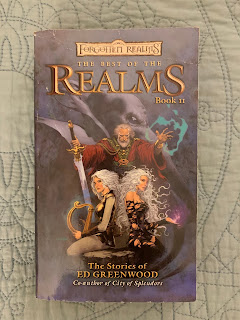
Far Too Many Thieves is the first of four stories cut from Elminster: The Making of a Mage, the first book of the Elminster series that you should read before this tale, which I thought was great (you can read my whole review here). Beyond the four cut stories, there is also a fifth story that takes place before the novel that can be found in The Best of the Realms II anthology. Far Too Many Thieves was released on the web in June of 2005 in celebration of the anthology's release a month later; it can be read for free here in the web archive.
![]() |
| Eladar the Dark |
This story is set during Elminster's time as a thief on the streets of Hastarl, when his alias was Eladar the Dark, as he was attempting to hide his identity as a Prince of Athalantar from the tyrannical magelords. This story would fit late into part two of Making of a Mage, as Farl and El have already formed the Velvet Hands, a band of thieves.
The story follows a falling out that occurred during the formation of the gang, as different parties vied for leadership. It’s nice to know what ended up happening to those who walked out, as we are left hanging in the book.
Our anti-heroes have a nice brawl with the Moonclaws, with daggers and arrows missing and hitting their targets. I appreciate how often they miss, as it makes them seem fallible compared to other fantasy stories, always hitting their targets. We learn the fate of the youth Rhegaer, who I was curious about because of his similar name to another character from another fantasy world that also has a similarly royal families symbol being a stag.
By the end, weakened by the assault, the Velvet Hands decide to get to the bottom of who is supplying the Moonclaws. This tale is very short and more of a first part of a chapter, that will likely be continued in the next stories. As it goes, it was a pleasure to be back on the streets of Hastarl with El, Farl, and Tassabra. Fans of the book should read this, it is Good.
--
Tuesday, March 23, 2021
Review: Elminster: The Making of a Mage by Ed Greenwood
Somewhat surprisingly this is not the first book Ed Greenwood wrote for the Forgotten Realms. Elminster has been a staple since he appeared in Dragon Magazine way back in 1981, but this book was released in 1994, after he had already written the first two books of Shandril’s Saga. As of right now, since the books in the series seem to follow standalone arcs, I will be reviewing the five books separately.
The prelude has 14th century Lord Mourngrym of Shadowdale searching for Elminster to no avail. He is left wondering about the origins of Elminster has he searches, and swiftly comes a prologue set more than a thousand years before as a mysterious lady known as Myrjala Darkeyes traveling through the remnants of Halangorn Forest, part of the Forlorn Hills in the kingdom of Athalantar, the ancient home of young Elminster. Right off the bat, we can say this is before 304 DR, as Tavaray is still around.
Athalantar, Elminster's homeland, does not exist in the 14th and 15th centuries of Dale Reckoning. In the Delimbiyr Vale, the capital Hastarl’s ruins were built upon to make Secomber. Some of the people of the kingdom became part of the Blue Bear Tribe and Tree Ghost Tribe of the Uthgardt; others settled in the regions of Baldur’s Gate. Personally after reading this, making a member of the Trumpettower family is really enticing.
The book is divided into parts, part one being called Brigand.
“. . . gods interested in the Kingdom of the Stag seemed in short supply these days.”
By chapter one you’ll notice epigraphs for each chapter, a very nice edition that I enjoy in just about any book. We also meet young Elminster, called El, as he watches over a flock of sheep outside of Heldon. We discover it is the Year of the Flaming Forest (probably in reference to Halangorn), which if you decide to look up, is 224 DR. Finally we learn that Elminster’s father, Elthryn, is Lord of Heldon. This truly feels like a different place from the Realms I am used to; the land is a wild petty kingdom with little order beyond whatever the most powerful person can enforce.
With so many ancient cities and nations thrown around, a map would have been helpful. There are even short references to Tyche, so we can surmise that the Dawn Cataclysm wasn’t quite complete by this point, as she is not yet the dual goddesses Tymora and Beshaba. This book is not as all over the place like many a Greenwood works are, it’s more meticulous and a steady march.
"Theives? Ah, such an ugly word . . . think of them instead as kings-in-training. Ye seem upset, even disputations. Well, then look upon them as the most honest sort of merchant."
![]() |
| The Annotated Elminster omnibus |
One sad thing I will mention, if you know Forgotten Realms, you know Elminster, we know he’ll be okay in this origin story because we know he becomes the Sage of Shadowdale. We also know what happens to a certain goddess in 1385 DR.
Part two was a lot more interesting than part one, and going into part three I was excited where the story would go, especially since this part was titled “Priest”, and since nothing is foreshadowed of that sort before hand, it’s not much of a spoiler. The story gets even more interesting and entertaining here.
As a lad, young Elminster takes the name Eladar to hide his identity from the forces of the magelords in Athalantar. Later he is given an even better disguise.
“You’re not a pretty lass.”
The tone of this story was refreshing, it was not full of a party of high adventurers on an epic quest (though there is a section with this), it’s long and challenging and personal. I really liked it, especially with the odd twist and turns El’s life takes.
This story is really magical, and getting closer to the end I started getting a little sad it was going to stop. I started to relish every page. Elminster doesn’t have it easy, if he did, the story would be about one third the size, and I am pretty sure Greenwood had to shorten the tale anyhow, as there are a handful of short stories about the Young Elminster in a few places.
“He told me the One True Spell was a woman, that her name was Mystra—and that her kisses were wonderful.”
Beyond our main protagonist of Elminster, there are other good characters that have that sense of verisimilitude and flare Greenwood conjures: Helm, Myrjala, Braer, Farl, Darrigo, Dorgon Heamiiolothtar (being the Magister Elminster met) were all fun to get to know.
A Star rushes past, to crash upon the shore
But the first of many many more
Stoke the fire and stout bar the door
For this is the night mages go to war.
Even though magic is quite promulgated in Faerun, this is a good example of wanton, arrogant power and distrust not making a sturdy ruling foundation. My love of the character of Elminster grew tenfold during this book. He’s so human, he fails, and has humor. The book wasn’t perfect, the first part especially was a tad dry, but at the end I had chills and, oddly, even some tears in my eye for such a good wrap up to the beginnings of the most legendary of mages in Faerun: Elminster Aumar, Prince of Athalantar, Wizard, Chosen of Mystra, and so much more. Elminster is on the level of Gandalf, Dumbledore, Rincewind and Merlin (his foibles making him the most similar) in my mind. Elmisnter: The Making of a Mage is Exceptional. I need to get my hands on The Annotated Elminster, or at least Elminster Ascending.
“. . . even gods grow lonely.”
--
Wednesday, March 17, 2021
Review: Haunted: A Tale of Sembia by Dave Gross
Haunted: A Tale of Sembia is a short story by Dave Gross that can be found in Dragon Magazine issue 304, published February 2003. The story is on pages 68-77. This is the last Sembia tie-in short story, both to be read by me and it is also the last published, as this was a month before the release of The Lord of Stormweather. You can check out my thoughts on other tie-in stories to Sembia through these links: And All the Sinners, Saints, Memories, Shamur's Wager, Another Name for Dawn, and Garden of Souls.
The story takes place mostly over a two day period in the month of Flamerule 1374 DR, The Year of Wild Magic. There is also flashbacks to Flamerule and Uktar in the Year of the Crown, 1351 DR. This story is a good story to read if you are a fan of the hideous aquatic vampire, Stannis Malveen, and his formidable brother, Radu, from Gross's Sembian novel, Black Wolf.
![]() |
| story art by Marc Sasso |
The tale starts in Selgaunt, unsurprisingly, but our characters are not on the bustling streets or in an opulent manse, but instead are in the fetid sewers beneath the port city. The characters, the shade Chaney and cursed Radu soon come across "Nightcarter[s]", another term for dungsweepers. I forgot how much I enjoyed their odd companionship.
There are a few flashbacks in this story, bringing up to Radu's youth when his mother was accused of piracy and the family stripped of holdings by the high probiter and held with extreme prejudice by the Old Chauncel. This story is the origin of the odd relationship that Radu has with his aquatic vampire elder brother: seeing the story art really shows just how hideous of a mephitic, nocturnal creature these are.
This story is Exceptional, and largely because the contrast between Radu and Stannis. Radu is human, though maybe a little tainted at this point, but is largely a monster with how terrible he acts and murders. Stannis is somewhat of a fop, and seems more human than his younger brother even though on the outside he is a grotesque creature with a monstrous appetite for feeding on living beings. Package this with the comedic relief of the shade of the Dandy Chaney Foxmantle, and we have a fun story on our hands.