Search The Forgotten Realms Lyceum

Showing posts with label Drizzt. Show all posts

Monday, July 29, 2024

Completed Series: Paths of Darkness by R. A. Salvatore

Paths of Darkness is the fourth series in the wider Legend of Drizzt. These days it is a trilogy but was originally published as a tetralogy. That’s because Servant of the Shard was put into the Sellswords Trilogy, the fifth sub-series. I started this one in November 2021 and finished in August 2023. I’ve preciously reviewed The Dark Elf Trilogy, The Icewind Dale Trilogy, and Legacy of the Drow. 


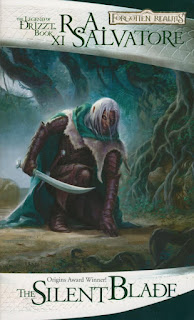
The Silent Blade (1998) - Exceptional

The Spine of the World (1999) - Mediocre

Sea of Swords (2001) - Acceptable

The Silent Blade is actually surprisingly fine. It is also the best in the series. It continues where Passage of Dawn left off, the Companions of the Hall are together again, even if Wulfgar is having problems. It’s a fun enough adventure and I have more thoughts here. You can watch it if you wish. 

The Spine of the World is generally considered the worst Drizzt novel, largely because it isn’t one. It’s a Wulfgar novel. I have previously reviewed it as well, and I will admit I was probably a bit lax in my criticisms because it was the first Drizzt novel I read after my friend passed away, and he was a Drizzt fan. If you want someone else’s thoughts, looks here. 

But I do have some thoughts on Wulfgar’s quest for redemption. He finds himself the bad guy and getting mixed up in events bigger than him. Even though it’s done by the ever clunky hand of Salvatore, I can appreciate redemption, even a gritty one. Read more thoughts here, watch here.

Sea of Swords is one I haven’t reviewed yet, so follow my thoughts.

In 1366 DR a pirate with a terrible name is out pirating. She is a target for the Sea Sprite. Not just because of her occupation but because she also has ownership of Aegis Fang. A half-elf, with no reason besides extreme racism also hunts down Drizzt. The Companions wish to be reunited with Wulfgar, who turns out is also at sea. 

There is some good action and adventure fans love. It’s monotonous and overdone after awhile, this is typical of the series. Of course we never fear for the Companions, all over powered and Drizzt very much a Mary Sue. This is the return that could never have happened and Drizzt could have sailed into the sunset and been written by other authors. (The precious 2 books are about other main characters.) 

Besides one moment of surprise I certainly would read no more of these if I wasn’t in my quest to read all Forgotten Realms novels. Overall the novels are better on average than the previous series, but not by a large margin which makes this Acceptable. 

Watch my review of Sea of Swords here.

Art by Clyde Caldwell for The Silent Blade that ended up not being used

--


You can track my current progress here.

Monday, October 23, 2023

What if Drizzt Was Written by Someone Other Than R. A. Salvatore?

Happy Day of Might to any that observe!

The title says it all: what if Drizzt had been written by someone else, specifically after the series had several entries and was popular? Shores of Dusk by Mark Anthony was not meant to be. The novel was written, and ads had appeared for it, but it has never seen the light of day and likely never will. I won't spoil the whole thing for you, but will show you to a write-up written by Anthony about the doomed novel. I was made aware of it by this recent Facebook post.

It is interesting to contemplate the direction Drizzt could have taken if Salvatore had actually hung up his hat. I have not read Realms of the Underdark and can't guess at how well Anthony may or may not have done. What do you think?


Here it is and amarast!:


Monday, July 31, 2023

Review: The Spine of the World by R.A. Salvatore

 The Spine of the World was released in 1999 and falls as number twelve in the ongoing Legend of Drizzt. Though it is part of the super series the main character is Wulfgar. In fact, Drizzt only appears in the narrative entries that separate the different sections of the novel. This is a sequel to The Silent Blade, as this starts with Wulfgar being a bouncer in Luskan just as he was in the previous novel.

I read this one in December 2022, right after finishing the Threat from the Sea trilogy.


The prologue shows Wulfgar at the docks with Morik, a recent friend set to watch over the barbarian by Jarlaxle. They are drinking and playing and are confronted by would-be-muggers. This interaction shows us the depressed and destitute state of Wulfgar. His lack of care may be costing The Cutlass, the tavern he works at, more money than he is now worth. 


Chapter 1 then shows the Sea Sprite, Captain Deudermonts ship, making its way into Luskan for repairs after an engagement with two pirate vessels.


Ch 2 shows us the Auck family of the village of Auckney to the Northwest of Luskan. The map at the front of the book is actually for the fiefdom of Auckney. This map puts Fireshear to the northwest when the text says it is to the south. 


The interludes are still from Drizzt and about his morals: he doesn’t like drugs for example and doesn’t think you should have sex with someone you don’t love but won’t judge if you do. 


The fighting is overdone, as always. 


The characters, especially just about all of them in Auckney are dislikable for the bad things they do, buuuuut, if you read this as Salvatore’s look at the plight of the poor, it kind of reads like Glenn Cook’s Shadows Linger. I think the expectations are wrong, and his characterization is not up to par; but it’s not terrible, though this novel is generally hated by Drizzt fans. 


Wulfgar is a thug, and a wretch; generally, what the Companions of the Hall fight. 


Does it end in tragedy? No, this is a redemption story that is actually done okay. I got quite emotional at the end even. Very unexpected. Almost Arthurian in some respects. 


Merelda is a tragic character, one the reader should pity. Jaka is my least favorite type of person in the world, the worst of toxic teenage boys. 


Most fans don’t like this novel, and since I’m not a huge fan of this series I thought maybe I would end up liking it. But no, it’s not that good. As is typical of Salvatore, I found it mediocre at best and maybe okay for tween boys.

--


You can track my current progress here.


Monday, December 6, 2021

Review: The Silent Blade by R.A. Salvatore

The Silent Blade is a 1998 novel by RA Salvatore and Book eleven in the Legend of Drizzt and book one in the Path of Darkness series. This of course takes place in the world of Forgotten Realms.it takes place in the year 1364 of Dale Reckoning, for those curious that’s about 130 years before the present fifth edition timeline. 


This will of course have some spoilers for the first ten books, beware. Read my thoughts on The Dark Elf Trilogy (books 1-3), The Icewind Dale Trilogy (books 4-6), and Legacy of the Drow (books 7-10). This review also has a video counterpart that can be watched here: https://youtu.be/W-1MnGOCzHM


It was nice having The Companions of the Hall back together even if their reunion in Passage to Dawn was lackluster. They of course start off at Icewind Dale and are leaving to bring Crenshinibon, the evil magical artificer commonly called The Crystal Shard, the south to Erlkazar to Spirit Soaring, temple to Deneir, in the mountains


Wulfgar is suffering, tormented by thoughts of Errtu in his nightmares. He’s no longer empathetic and his friends try to get him to feel again.


Entreri is back, he thankfully wasn’t present in the previous book, and I’m still of the opinion he should have died several books ago, but I digress. Entreri has returned to Calimport thousands of leagues to the south of Ten Towns in Icewind Dale, the furthest part of the Sword Coast still on it. These storylines. Initially don’t seem connected, besides the characters past connections. They do start connecting about half way through.


Part one sets up the Compnions storyline and Entreri’s, and honestly there was little combat in part one, and it was hardly drawn out 8 was really enjoying this, reminded me of the earlier Drizzt books. Wulfgars torment is deep, and it seems even friends or the old thrill of battle won’t dissipate his demons.


Part two brings Wulfgar more to the forefront, and his second encounter with a tribe of Uthgardt, the Sky Ponies, last seen in Streams of Silver was a greater view of the Companions past but also a larger view of the Forgotten Realms I often feel Salvatore misses in his works, seemingly forgetting them.


Jaraxle does make an appearance as well, a welcome one with his typical bravado and his webs of intrigue. Of the drow of Menzoberranzan, he is by far the most nuanced and interesting to read about. Though admittedly the guilds in Calimport sort of play the part of the warring houses of the drow city in this book. I much preferred this than the destructive and chaotic drow house wars which were a huge chunk of their society while the guild wars are just a piece. 


Cadderly is mentioned several times, but doesn’t actually make an appearance here. While he does appear briefly in Passage to Dawn, for those unaware, Salvatore wrote The Cleric Quintet that introduces the priest of Deneir and his friends.


This book also amps up the sexual content, but not in a gross amount. It felt more  adult rather than the juvenile feeling lots of the other Drizzt books had. 


I finished Pssage to Dawn all the way back in August of 2020, I needed a big break from Drizzt and that break helped a lot. I enjoyed this one throughly though my pace wasn’t the best. I’d say it’s Exceptional, considering how the other Drizzt books have gone.

--


You can track my current progress here.

Monday, July 12, 2021

Review: Realms of War

 Realms of War is an anthology edited by Philip Athans and released in early 2008. It accompanied the Twilight War trilogy by Paul S. Kemp that I recently finished (review here), and fell in-between the releases of the second and third books. This is only my second anthology set in the Forgotten Realms that I have read, the first being The Halls of Stormweather that introduced the Sembia series (review here). Like many "Realms of ..." anthologies, this one focuses on wars of Faerûn, spanning millennia of conflict.


"Continuum" by Paul S. Kemp

Our first story is about Rivalen Tanthul, Prince of Shade Enclave. It starts off in -365 DR, in the beautiful woods of Arnothoi, the lands that will one day become Sembia. He is in a meadow with his mother, whom he plans to murder to complete his devotion to the Goddess of Darkness, Shar. The story jumps to 1374 DR, during the events of the trilogy. We see more of Rivalen, as well as his brother Brennus. We also see some of Varra, Erevis Cale’s lover. This was a nice story that showed some things not explained beyond a sentence or two in the novels. We also get Rivalen’s thoughts on Elyril. Like most things from Kemp in the Realms, this story is Exceptional. You could read this in between Shadowstorm and Shadowrealm.

“Weasel’s Run” by Lisa Smedman

We meet Weasel, a spriggan trapped by a Ghostwise halfling cleric of Malar the Beastlord for the High Hunt. We discover he is a scout for the armies of Luiren, and we get to see some of his early days in this position in a flashback to -68 DR, while the rest of the story takes place in -65 DR. This is during the Hin Ghostwars in Lluirwood. It’s interesting as these Ghostwise halflings still speak, and it’s only after the war is over and they’ve moved to Chondalwood that they take their silent ways we know of in the modern Realms. We see some creatures I honestly haven’t ever experienced playing at the table or in my reading. This story is Exceptional.

“The Last Paladin of Ilmater” by Susan J. Morris

We find ourselves in 902 DR at the Chondalwood. Jaeriko, a druid, is our POV as she follows Maze, an assassin in service of the city-state of Reth during the Rotting War. This civil war split Chondath into loosely allied city-states and allowed their Sembian colonies, Chondathan and Chauncelgaunt, to gain independence. The duo face undead raised by the necromantic general of Arrabar, a fallen adherent of Ilmater, god of suffering. This is an interesting tale, somewhat disturbing, with an intriguing ending: overall it is Good.

“Black Arrow” by Bruce R. Cordell

Spring of 1095 DR in Sarshel, a port city of Impiltur, a kingdom of the Easting Reach. The story begins with a letter of condolences to a Madame Feor about the death of her son Jotharam. This letter is from Imphras Heltharn, who in a few short years will become the first king Impiltur has had in 100 years. We then start our story following a young Jotharam. This sense of doom hangs over you as you read of the naive young man and his dreams of grandeur as a warrior defending the walls of Sarshel. A surprise attack from a goblinoid army sends people scrambling. This was super fun for me, I’m a big fan of Triad worshipping Impiltur but had actually yet to read any fiction set there before this. I had chills and tears come to my eyes, I was honestly really surprised. This reminded me of some of the memorable prologues from Jordan’s Wheel of Time. This short tale is nothing short of Amazing. 

“Too Many Princes” by Ed Greenwood 

A tale of Mirt the Moneylender, during his time as mercenary when he had the moniker “the Merciless”. The year is 1333 DR, and Amn is in a war of succession. Mirt is in Ombreir, a citadel of the Araunvols. A wicked vizier means to trap Mirt and others: it was fun to read how he saves their skins, though one of the Seven Sisters does most of the work. A Good story from Mr. Greenwood, unsurprisingly.

“The Siege of Zerith Hold”  by Jess Lebow

Goblins from the High Peaks and Kuldin Peaks threaten Erlkazar. Zerith Hold in Duhlnarim (the home of Atreus from Faces of Deception) holds fast against the onslaught as the crusaders wait for help from Korox. The year is 1358 DR, the Goblin Wars rage in the newly Independent country. Our characters are Jivam Tammsel, a half-elf, half-steel dragon ranger, and Lord Pudrun who leads the efforts at Zerith. This is the same country the Cleric Quintet takes place in for the most part (though Salvatore seems to have forgotten that), if you want more stories in this country, Lebow also wrote the novel Obsidian Ridge, which takes place in Erlkazar less than a decade after these events. Valon is incorrectly refferred to as a Baron rather than Duke before coming King. Beyond this, this short tale was a nice opening course and I want more. It is Good.

“Mercy’s Reward” by Mark Sehestedt

Gethred is someone in or near Rashemen, though he is not a rashemi, he seems to be running from Tuigan. The year is 1359 DR, an these events can be further explored in the Empires Trilogy. Persistent pursuing enemies abound, shape changers face off, this is one wild ride. It’s a decent, Good tale.

“Redemption” by Elaine Cunningham 

Ferret, an elf of the Wealdath in Tethyr during the Reclamation War, puts her people first in 1368 DR. The transition from one character to the next at the beginning of this tale was so expertly done I was hooked. We see Cunningham‘a famous characters Danilo, Elaith, and Arilyn. Oddly enough there is also a lythari in this tale, just as there were in the last. We learn some of Myth Rhynn and Mallin, a lich. This is a Good story, though I still need to read the novels involving these characters.

“Changing Tides “ by Mel Odom

Rytagir Volak was an explorer on the Sea of Fallen Stars in the year 1369 DR. A lover of the sea, he is in search of the shipwreck for Peilam’s Nose. A bargain with sea elves is made, something I wasn’t quite expecting but was realistic and fun to read. A fun introduction to the Threat From the Sea series by Odom, and the Twelfth Serôs War. A Good tale in Odom fashion.

“Chase the Dark” by Jaleigh Johnson 

The year is 1370 DR and Devlin Torthil is a trickster magician in Amn during the Sythillisian Uprising. Ogres have been attacking the western cities. Dev is an interesting character, and learning his background like the character design. Overall he was a little too blustery and slightly annoying more than charming. Still a decent story, this one was Acceptable.

“Bones and Stones” by R.A. Salvatore

This tale is also set in 1370 DR, the aftermath of a battle outside Mithral Hall has left both the dwarf Thibbledorf Pwent and the orc G’nurk with the pain of loss. We also get Drizzt’s journal entries throughout, they’re not annoying this time around . This was actually really nice, I was admittedly a little scared since the last handful of books I’ve read by Salvatore haven’t been the best. This, this was nice. Though the fight did last a tad too long, it was well written as always. It’s a Good tale. I’m not actually this far in the Legend if Drizzt yet: this is somewhere around The Thousand Orcs or The Two Swords. This story was later republished in The Collected Stories: The Legend of Drizzt Anthology.

“Second Chance” by Richard Lee Byers 

The year is 1375 DR, and Kemas is in Thay. This likely corresponds with Byer’s The Haunted Lands Trilogy set in the same year in Thay. Kemas is a member of the Order of the Fire Drake in the church of Kossuth. He teams up. involuntarily, with Bareris against Szass Tam’s coup. This is a tale of a young man finding courage in the face of truly terrifying odds. It is Good.


Overall I’m happy with this anthology. I hope that future compilations of this sort as as rewarding. It was a little bit of a trudge getting through with all the notes I had to take since the characters and setting changed so often. Overall, this was a refreshing, Good exploration of many of the Forgotten Realms.

--


You can track my current progress here.


Monday, July 5, 2021

Dungeons & Dragons: Dark Alliance - How good is it?

In my post two weeks ago I mentioned I was going to give some thoughts on the new Dungeons & Dragons video game: Dark Alliance. While I’ve yet to complete the game I have played several hours and have a level eight character. I would still like to play more. 

Dark Alliance is a sort of reboot or spiritual successor to Baldur’s Gate: Dark Alliance, a spin-off of the Baldur’s Gate video game series. It’s an action RPG, meaning strong focus is on fast-paced “kill everything in sight” combat. It’s decent fun with friends, but a little on the challenging side when playing solo.  

The game is nice to look at, even on my original Xbox One from 2013. Though I still find more appeal in the style of a game like Neverwinter (2013 MMO) more. For example Kelvin’s Cairn is huge. The home of Clan Battlehammer is large and epically extravagant, unlike its book counterpart. The game definitely has a multiplicity of bugs and glitches currently as well.

a tablet of Ostoria
Lore wise, it’s 1356 DR, just after The Crystal Shard. Obviously the books don’t acknowledge these events. The game gets its name from the loose alliance the leaders of many evil factions set against the Companions of the Hall. Regis is not a playable character, so be aware. There also is no caster to play as, since no one at this stage is in the books. 

You face factions of ice giants, goblins, duergar, and undead under the leadership of a returned Akar Kessell (I’m not sure if this would mess with any lore of Legacy of the Crystal Shard adventure). We also have Icewind, the mate of Icingdeath, which they retconned to say she is the namesake behind the Dale. The tone is very much not serious, and if you’re a big fan of lore there honestly isn’t much here. There are tomes and tablets that are interesting to look at however, but most lore is rather basic. Many of these tablets are from ancient giant society, specifically from Ostoria Oddly they don’t use dethek, but the logographic runes for divination purposes shown in Storm King’s Thunder. 

Unsurprisingly to anyone who reads this blog regularly, I’m not happy that they chose these characters. They stuck themselves over 100 years before the current D&D plot line, give us silly enemies, and make it known that they didn’t really have much of a Realms expert on hand that could have really made the game awesome for a lore junky like me. I think so lesser known characters, or even some new ones set during current events would have been better, but Drizzt makes up some sales when the game isn't outstanding.

Overall, as mindless fun, it works. If you want good lore, I’d bet on the upcoming Baldur’s Gate 3 for more goodies. If you happen to be a huge fan of the Legend of Drizzt, this could also be your thing. I will play a little more but I think after that I will likely put the game down and I don't know if I'll ever come back. 

Have you played? What are your thoughts?

--


You can track my current progress here.

Tuesday, March 2, 2021

Completed Series: The Cleric Quintet by R.A. Salvatore

An aptly named quintet, five books about a cleric of Deneir, the god of knowledge. The Cleric Quintet has some characters that can be found in book ten of The Legend of Drizzt, Passage to Dawn. For that reason you may want to read these if you want to know these characters, and if you particularly enjoy Salvatore's writing. The entire series takes place in and on both sides of the Snowflake Mountains, on the border of Tethyr and Erlkazar.


I read these five books from the beginning of December to the end of February. I still am not a huge fan of Salvatore's writing, and so I needed space between the books. I hope my dislike of the author doesn't show too much, but I promise these views are straight from my heart.


the original covers

Canticle (1991) - Good
In Sylvan Shadows (1992) - Acceptable

Night Masks (1992) - Mediocre

The Fallen Fortress (1993) - Mediocre

The Chaos Curse (1994) - Ugly


Canticle

We are first introduced to an evil mage who is a worshipper of Talona. He is getting the last ingredient for a potent elixir. The story takes place 1361 DR, a few years after the Time of Troubles. 


After a short prologue we meet our protagonist, Cadderly. The cover shows Cadderly, priest of Deneir, as blonde though on page 7, our first description of him says he has “curly brown locks” but only a few paragraphs later we read that he is “blonde-haired”; this is confusing.


Cadderly seems to have a perfect memory of sorts, reminds me of Icelin Tearn from Mistshore, though as the series goes on we see this is not really the case, he is just exceptionally bright, though this is told more than shown.


Also as an acolyte of Deneir, he shows tendencies more behavioral of a that of Gondish priest.


At this point, Cadderly has never had any adventures; he is young and carefree. We soon find that the monk Danica and him are about to embark on life changing events. In this book Danica and Cadderly have a juvenile relationship, you could call it silly.


The main villain of this book is seen quite often, which is nice, though he is not very bright. For example, I don’t see why the dweomer for innocence was attached to the chaos curse, and is Cadderly truly innocent? This is also completely absent in book five.


Takes a little while for the ball to get rolling but it’s engrossing when it does. I actually stayed up to finish this one. For the most part we get steortypical characters that are borderline absurd. My favorite character by far was the druid Newander, sadly this is the only book the druids are so important.


In Sylvan Shadows

Five weeks after the first book, Cadderly must Journey to Shilmista, an elven Forest on the north face of the Snowflake Mountains.


Chapter 1 we are introduced to multiple elves with silly names, most of Salvatore’s names are juvenile. I was reminded that Salvatore has as odd view of females that comes out when he writes of them, it reminds me of Dracula and how each guy fawns over the amazing, beautiful, maiden. It’s sort of gross.


We get some phrases in this book that break the immersion of a fantasy world. We also get some elvish words, though Salvatore is no linguist, it was fun to break apart for meanings. I like the ancient forest filled with Sylvan elves theme, this made up for the slow story.


Leave it to Salvatore, where elvish has cryshal for crystal and trea for trees, how elementary. 


One great plus is just how human Cadderly is in this book, as he struggles with the reality of the wider world beyond the walls of the Edificant Library.


Night Masks

Yet again introduced to another villain just like the previous prologues. Sadly, Ghost comes off as comical though his power is supposed to be feared, but I can’t take his amazing power seriously when I know clueless Cadderly will defeat him in the end.


Cadderly begins thinking about how he doesn’t have a home, though how the Edificant Library isn’t his home doesn’t quite sit well with me, I think Salvatore is pushing for emotional sympathy to our protagonist but he’s just not a good enough writer to actually make me care about Cadderly‘a inner turmoil.


At this point I was no longer confusing Aballister with alabaster.


In reality the story is going a nicer direction, but its bogged down by juvenility, such as the Salvatore’s inability to write good romance that is only bad because he incessantly tries to shoehorn it in. Anyway, we are shortly introduced to the Night Masks out of Westgate, sent for by Bogo Rath, the youngest and least powerful wizard in service to Talona. Somehow he avoided death when he left, something which is mentioned. This is two years after Erevis Cale’s escape from the group that is told in Another Name for Dawn, so likely these characters were contemporary, but of course Cale’s character wasn’t created by Kemp until later in the decade.


It’s interesting to see a firbolg so different from its fifth edition incarnation. We also finally get a good glimpse of the Tome of Universal Harmony, the sacred text of Deneir. 


In a story and world where gods very obviously and evidently exist it’s silly to have to read about a characters inner turmoil involving atheism or agnosticism. I feel this is Salvatore’s personal thoughts bleeding into his work, but our world is not The Realms and it detracts from the story. I found similar thoughts occur in Drizzt books.


Salvatore never learned what a synonym is since Rufo is called the “angular man” probably hundreds of times, it’s inane. The timeline of this book is a little confusing, but just don't think about it.


Another plus, it is refreshing to see the struggle and turmoil that can come about from taking another human life, something that is too often brushed over by fantasy authors.


Another minus, after using the most basic clerical spell during In Sylvan Shadows (admittedly to profound effect), the rapid pace at which very high level spells are gained in Night Masks is laughable. Unlike the first two books, I slowly started to care less and less, and found it hard to pick this book back up when I put it down.


The conclusion was quite good, and at this point I think Rufo is a very interesting character, he is so torn because of his weak resolve in a dangerous world. Sadly his arc goes downhill, even though the fall is a bit delayed.


The Fallen Fortress

I decided I would change things up and do this one in audiobook format. Though I get through books a lot slower this way, I thought it might help my enjoyment go up since I was having a problem with Salvatore’s writing. This helped me to take a sort of backseat, and while I was less engrossed I did enjoy my time a little more. I also learned how to say some of the names properly doing this. 


Omnibus of the series

At this point Cadderly is a caster with no limits on spells he can cast in both number and power. He had a whole book of spells that became usable almost all at once. 


Overly competent heroes, but woefully under competent villains that are suppose to be powerful and intelligent makes this a circus of a read.


Knowing my opinions of the last few books, at this point it was hard to care for the characters and their story. I feel my opinion and rating is marked by this bias, but I still want to accomplish my goal of reading all the novels in the Realms. I feel like this is unfair and I want to make that clear. Plenty of people will enjoy this series. Remember that my ratings are to have some sense of my thoughts condensed into a single word, and it’s all my opinion.


There is a dragon in this book, as the omnibus shows. Fyren’s relationship with the party is somewhat akin to Mist in Azure Bonds, though Fyren seems inordinately of low intelligence. Do not expect a Smaug/Bilbo dynamic, though the the conclusion is a lot more unique than any other confrontation with dragons I’ve ever experienced. 

Tons of fighting near the end, in Salvatore fashion Where you don’t fear for the characters and know the hordes they go against will perish almost with no sweat.

I liked the clever healing at the end, and it seemed most arcs could have been tied up, but alas, maybe five sounds better than four and so there is a fifth book...

The Chaos Curse
To tie into the events of the first book. The large arc has been accomplished, but it seems Salvatore wants to tie up all the threads. This probably should have been a standalone novel. Cadderly is not a wimp anymore and now has full faith with his god.

Since the series could have ended I hoped for some twist to be revealed at the start, and we got it. I was both intrigued that we actually got something, and disappointed. Rufo was the most dynamic character, though Salvatore loves his absolutes. Evil is evil and for some reason, Rufo, who simply had personality unlike the robotlike other characters, and a fine arc up to this point was ruined because Salvatore wanted him to be worse than he had been written to be. He constantly betrays, but never to his betterment. He has no spine but that doesn't make you evil.

When we finally get to Cadderly in chapter two we have more silly interaction. Why is his return to the Edificant Library described as his “toughest challenge yet”? Considering the arc of the series was resolved in book four, and all that is expected is Cadderly to face the consequences of how poorly he treated his superiors, this doesn't make any sense.

If you want your clerics devout, Cadderly finally is here in book five. If you liked Newander in book one, we get a little more druidic attention in this last book. If you like undead enemies, particularly vampires, this has them. But absolutely, this book should not have been part of the series, and Salvatore shows once again that he may occasionally write a good book, but that most of his works are not worth it. I could probably recommend this to 10-13 year olds, but there are better things to recommend to that age group.

With hundreds of Forgotten Realms novels not all of them will be good. Some will be mediocre, some amazing, and others terrible. I hope I shared enough objective things so you can know if you will like these books, but for me personally this series is Poor. You will probably like them if you think the Drizzt books are great, and if that’s the case; read these. I do not plan on torturing myself with another Salvatore book for half a year.

--


You can track my current progress here.

Wednesday, November 4, 2020

Review: The Thweem by Adam Lee

 The Thweem is a short story "by Chris Perkins, written by Adam Lee", whatever that collaboration means. It can be found for free in Dragon+ issue 4, published October 2015. The short story is a tie-in to the Rage of Demons storyline. It is a short tale about a flumph named Freemo and its experience in the Underdark during the tumult of 1485-1486 DR.

A flumph

Flumph's are one of the only good species of the subterranean Realms; as the fifth edition Monster Manual states: "Trust a flumph". They speak telepathically together in their little cloisters, a look as shown above.

The tale itself revolves around thweem, as one could probably guess from the title. Thweem, known as Faerzress to the drow, is an odd sort of magical radiation only found in the Underdark. During the story the thweem becomes contaminated and infects Freemo, who becomes irritated and aggressive, or full of rage.

Following his infection he subsequently leaves his cloister of flumph (flumphs? flumphi?) and has an encounter with mind flayers and their undead Elder Brain. The story is really silly, uses a handful of juvenile insults, and I think most would find it appropriate for younger audiences. Like Ice Out, it is also written in first person, which may help younger audiences enjoy the story more. The most confusing part with the storytelling though is the lack of quotation marks. Most dialogue is inner monologue, and when the flumph communicate with each other it is telepathically, and no quotation marks are used, neither are the thoughts indicated otherwise, such as with italics. The only time quotation marks are present is for the brief moment humans are present and speak, and one time the Elder Brain says "what", which is probably a mistake; as far as I know they can't project a voice beyond psionic means.

Overall The Thweem is fun short story. For those who like Drizzt, you will receive a pleasant surprise of a cameo at the end of the story. I enjoyed my time reading the story, and it was fun being in Freemo's alien head. I think The Thweem is Good, and I'd encourage those fans of the darker parts of the Forgotten Realms to get a little taste of the Underdark in this tale.

--


You can track my current progress here.

Sunday, August 9, 2020

Completed Series: The Legacy of the Drow by R.A. Salvatore

 The Legacy of the Drow is a four book series by author RA Salvatore. It is the third series comprising the Legend of Drizzt, and as such follows the adventures of The Companions of the Hall: Drizzt, Bruenor, Wulfgar, Cattie-Brie, Regis, and Guenhwyvar. Focusing in large part on Drizzt Do'Urden and his origins in the dark elf city of Menzoberranzan fans of the Dark Elf Trilogy would enjoy the mechanizations of the chaotic and evil drow society.

This is the last of the series that I had already started before starting on my quest to read every novel in the Forgotten Realms. I read the first book in March of 2019, and the follow up with the second a few months later. In April of this year I read the third book (review here), and I finished the fourth and last book in August.

the modern covers

The Legacy (1992) - Acceptable

Starless Night (1993) - Acceptable

Siege of Darkness (1994) - Good

Passage to Dawn (1996) - Mediocre


The Legacy of the Drow (TLD) is a conundrum for me. If you have read my previous reviews of Salvatore's Drizzt books you will know I generally find them overrated and often a little infuriating. Salvatore writes fight-scenes well, but his characters and plots are nothing praiseworthy. Overall TLD is a decent foray into the fun ride that can be the Forgotten Realms, it is not where I would start though, nor where I would end.

I readily admit it has been some time since I read the first two books in this series so I ask you take my opinions with a grain of salt for those two. I will try to keep the them as simple as possible.

The Legacy is okay. It is a story of Drizzt's past coming back to haunt him, for the evil worshippers of Lolth are not yet down with him. He is taken to Menzoberranzan. Wulfgar acts unlike himself in this book, his character arc being a little odd. Entreri is one of the most dull villains ever and I'm waiting for the day that Salvatore actually kills him, because it should have happened back in The Hafling's Gem.

Starless Night is basically the same as The Legacy. The Companions go back to Menzoberranzan. Entreri still is not dead.

Siege of Darkness was ironically the highlight of TLD. It focuses on greater cosmology of the Forgotten Realms with the Time of Troubles. The fated assault on Mithral Hall finally comes to pass and it has plenty of interesting combat. Interesting events happen in this book that I enjoyed reading. Overall it is a good book. Again, here is a more complete review.

Passage to Dawn is an odd book. I have a large amount to say since I just finished it at the time of this writing. The book starts off tremendously entertaining. Cattie-Brie and Drizzt are really the main focuses to begin with. This book does not involve the Drow at all, for which I am grateful. It is more of a proper sequel to Errtu's hatred of Drizzt and a proper sequel to The Crystal Shard. It is the first book to take place partially in Icewind Dale since The Crystal Shard (ironically the only book in The Icewind Dale Trilogy to take place in the Dale) and so deals with Crenshinibon, the Crystal Shard.

The beginning of the story is of adventures with Captain Deudermont of Waterdeep on his ship, the Sea Sprite. It is fun and exciting. The general endless fighting of Drizzt books is noticeably and pleasantly absent from the first half. 

Moving on the book changes and I will now get into more spoilers.

The companions eventually reunite in Icewind Dale. A seer on the mystical island of Caerwich tells a riddle of one held captive, someone important to both Drizzt and Cattie-Brie. The prologue of the book shows that Errtu has someone, but it does not reveal who. It was insanely obvious to me that this was Wulfgar. It makes sense, that is someone who was killed by a demon and is important to both Cattie-Brie and Drizzt. But no, Salvatore is so bad at subtlety and he makes the characters think it is Zaknafein; which does not make much sense if this prisoner is suppose to be relatable to Cattie-Brie. The entire book Wulfgar is hardly mentioned, and never as a potential prisoner of Errtu when it is obvious from page 1. 

At about the half-way point, I was thinking Salvatore was trying to come full circle with The Crystal Shard and the Companions of the Hall; his original story. Wulfgar is returned (though with the most lackluster reunion I have ever read, he doesn't even say anything for pages and when he does speak it is a smattering of a couple lines), and Crenshinibon is well in hand. I was hoping this would be end of the story for the Crystal Shard so I could study up on The D&D Next adventure The Legacy of the Crystal Shard before the release of Rime of the Frostmaiden in September. Sadly it is not so.

Salvatore shows great immaturities as a writer, the first half is littered with sentences ending in exclamation marks that sound like the author himself and not the characters. These could and should have been caught by an editor. Cryshal-Tirith, present in previous books, is supposedly the elvish word for "Crystal Tower". Considering the t in crystal was just changed to an h and Tirith was pulled from Tolkien's Minas Tirith, it seems rather juvenile. Also Khazid'hea's sentience seems mostly forgotten, with a few lines thrown in near the end. And apparently Salvatore forgot that Drizzt's scimitar is called Icingdeath (the companion to Twinkle). Salvatore also insists on repeating silly statements like "Creatures venturing out onto the open plain of Icewind Dale who were not careful did not survive for long." with little change.

Overall Passage to Dawn is a long road of going down and maybe should be called Passage Down instead. Thank Tymora Entreri does not appear in the book.


The Legacy of the Drow has it's ups and it's downs. The series does finish on a solid endnote, and I feel anyone could be satisfied finishing Drizzt's story here. Salvatore shows that he can consistently write Dungeons & Dragons novels but the quality is questionable. Sadly the series has more low points than high ones, and though I am surely biased and mayhap even ranting I would say that the series is Acceptable.

From here on out the reviews should be more balanced with each book getting equal representation. 

--


You can track my current progress here.