Search The Forgotten Realms Lyceum

Monday, December 27, 2021

Review: Shadowdale by Scott Ciencin

Shadowdale is the first of the Avatar Series, what was originally a trilogy but later expanded to five books. It was written by Scott Ciencin though originally published under the pen name Richard Awlinson. There is an Advanced Dungeons & Dragons Module of the same name that corresponds with the events of the book. 

This review has  corresponding video which you can watch here.

Original cover

The story starts with the gods and goddesses of the Forgotten Realms gathered together by Lord Ao. They are the target of his wrath for some of them have stolen the tablets of Fate. As a result, the Avatar crisis ensues as the gods are cut off from their realms and godhood, so prayers and magic go unanswered and become unreliable, while the gods are made to walk the planet Toril in mortal avatar form. The only one not cast down is Helm, God of Guardians. 

The year is 1358 DR and so begins the Time of Troubles, also called the Arrival, the Godswar, and the Avatar Crisis. This is also the beginning of the Era of Upheavel which will end over 100 years later with the Second Sundering. 

With the deities casting out, we first see Mystra, goddess of magic, try to access the Weave, yet deification form at which all magic of the Art comes, and she fails. Then Bane, god of hate, terror, and tyrannical oppression, lands in Zhentil Keep and takes and avatar as he sets about his malevolent plan to acquire the Tablets of Fate. 

Near the city of Arabel in Cormyr, the mage Midnight awakens to find things not as she left them, most notably she has a strange amulet around her neck. Her and 3 other heroes find themselves im the midst of the power struggle of the deities and their minions. 

One of the others is Kelemvor a sellsword warrior also in Arabel during the events of the Arrival. He is a little moody and not much of a people person, but still honorable and pretty average in his temperament besides his glaring misogyny, which is kinda out of place in the Forgotten Realms. He is acquainted with Cyric as they recently went after the artifact The Ring of Winter. He is approached by a starving waif on the streets who seems to have a quest in a mind for him. 

Reprint cover

 Cyric is a thief turned mercenary. Honestly my favorite character, which is funny if you know what becomes of him.

Then we have Adon, à Cleric of Sune Firehair, goddess of Beauty. He is familiar with Cyric and Kelemvor as he was also used by Lady Lord Myrmeen Lhal, ruler of Arabel to bring down a conspiracy. Adon is certainly vain and a little arrogant and foolish. 

I found Ciencin’s descriptions of simple character actions to be written perfectly, where I was getting imagery for mundane things I often don’t get while reading. The characters all decently explored too, for example finding out more about Kelemvor’s past, and how his curse really harms his temperament.

The pacing is a little slow, for example chapter 6 is somewhat dreamlike and dragging. Chapter 7 fixes this.

There are a decent amount of deities talked about with only the most basic of descriptions, so those unfamiliar with the pantheon  be lost with the mention of gods and goddesses. 

Divine magic only works for clerics within a mile of their deities avatars, while arcane magic that normally comes from Mystra, Goddess of Magic and her weave is terrible inconsistent and dangerous to use. 

The gods most at play here are Mystra, Bane, Helm, and Myrkul Lord of the Dead. This conflict really gets heated about the halfway point and that made the book finally hold more of my attention. 

As the back of the book states, the party wants to eventually get to Elminster in Shadowdale, hence the title of the book. Those two things had me thinking a majority of the book in Shadowdale, but only the last bit actually is. The party goes from Arabel to Castle Kilgrave, to Tilverton, to Shadow Gap, to Spiderhaunt Woods before reaching the titular place.

There is a romantic relationship I didn’t really care for as one of the people in the relationship wasn’t really a good prospect. 

The story does end with a cliffhanger that left me saying what the heck. Overall it’s Good, though maybe barely so. I have not been itching too bad to get to the next book, but I am looking forward to how the story develops.

--


You can track my current progress here.

Monday, December 6, 2021

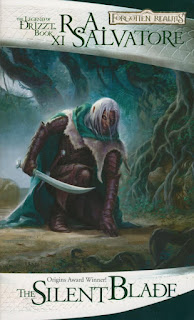
Review: The Silent Blade by R.A. Salvatore

The Silent Blade is a 1998 novel by RA Salvatore and Book eleven in the Legend of Drizzt and book one in the Path of Darkness series. This of course takes place in the world of Forgotten Realms.it takes place in the year 1364 of Dale Reckoning, for those curious that’s about 130 years before the present fifth edition timeline. 


This will of course have some spoilers for the first ten books, beware. Read my thoughts on The Dark Elf Trilogy (books 1-3), The Icewind Dale Trilogy (books 4-6), and Legacy of the Drow (books 7-10). This review also has a video counterpart that can be watched here: https://youtu.be/W-1MnGOCzHM


It was nice having The Companions of the Hall back together even if their reunion in Passage to Dawn was lackluster. They of course start off at Icewind Dale and are leaving to bring Crenshinibon, the evil magical artificer commonly called The Crystal Shard, the south to Erlkazar to Spirit Soaring, temple to Deneir, in the mountains


Wulfgar is suffering, tormented by thoughts of Errtu in his nightmares. He’s no longer empathetic and his friends try to get him to feel again.


Entreri is back, he thankfully wasn’t present in the previous book, and I’m still of the opinion he should have died several books ago, but I digress. Entreri has returned to Calimport thousands of leagues to the south of Ten Towns in Icewind Dale, the furthest part of the Sword Coast still on it. These storylines. Initially don’t seem connected, besides the characters past connections. They do start connecting about half way through.


Part one sets up the Compnions storyline and Entreri’s, and honestly there was little combat in part one, and it was hardly drawn out 8 was really enjoying this, reminded me of the earlier Drizzt books. Wulfgars torment is deep, and it seems even friends or the old thrill of battle won’t dissipate his demons.


Part two brings Wulfgar more to the forefront, and his second encounter with a tribe of Uthgardt, the Sky Ponies, last seen in Streams of Silver was a greater view of the Companions past but also a larger view of the Forgotten Realms I often feel Salvatore misses in his works, seemingly forgetting them.


Jaraxle does make an appearance as well, a welcome one with his typical bravado and his webs of intrigue. Of the drow of Menzoberranzan, he is by far the most nuanced and interesting to read about. Though admittedly the guilds in Calimport sort of play the part of the warring houses of the drow city in this book. I much preferred this than the destructive and chaotic drow house wars which were a huge chunk of their society while the guild wars are just a piece. 


Cadderly is mentioned several times, but doesn’t actually make an appearance here. While he does appear briefly in Passage to Dawn, for those unaware, Salvatore wrote The Cleric Quintet that introduces the priest of Deneir and his friends.


This book also amps up the sexual content, but not in a gross amount. It felt more  adult rather than the juvenile feeling lots of the other Drizzt books had. 


I finished Pssage to Dawn all the way back in August of 2020, I needed a big break from Drizzt and that break helped a lot. I enjoyed this one throughly though my pace wasn’t the best. I’d say it’s Exceptional, considering how the other Drizzt books have gone.

--


You can track my current progress here.

Monday, September 6, 2021

Announcement: YouTube Channel and Playtesting

Oloré, this weeks post will just be a short announcement. At the end of July I started a YouTube channel focused on books: https://youtube.com/channel/UCy3nRShupS4JmniQ7EG3hYw

I have done a couple on Forgotten Realms books which I’ll link below. Otherwise it’s also been a good opportunity to talk about other books that I read. Such as Appendix N books that influenced Gygax’s creation of Dungeons & Dragons among other works. 

If you like your content in video format, this may be for you. Anyways, next week I’ll be back with another review!

Erevis Cale Saga Overview:

https://youtu.be/GB89zMBaMZ0

Elminster: The Making of a Mage review: 

https://youtu.be/st8tBs0b1z4


I have also had the opportunity for the pat month to participate in playtesting the first adventure for a new setting over on Tim “Renfail” Anderson’s channel. It’s been great fun, and we are about to wrap up. The sessions have been streamed every Wednesday at 8:30 pm Central time for those interested.

Here’s the first sessions recording:

https://youtu.be/E4I8dvmdRDg

--


You can track my current progress here.

Monday, August 30, 2021

Review: The Reaver by Richard Lee Byers

The Reaver is a standalone book by Richard Lee Byers set in the Forgotten Realms during the events of The Sundering, when the cosmology got smacked around and gods were reborn and many changes brought by the Spellplague were brought back.

The Reaver is technically book four of The Sundering book series, but they’re all effectively standalone, though one character from The Reaver makes a cameo in the fifth book, The Sentinel by Troy Denning. And technically Stedd first appeared in book 3, The Adversary, but that was just a small introduction to him. The whole Sundering series is one of the few Forgotten Realms books you’ll find at Barnes and Noble these days.

The Reaver introduces us to some pirates of the Sea of Fallen Stars somewhere near the city of Teziir on the Dragon Coast. The Inner Sea has been wracked with endless storms in this time of upheaval. Our main characters are Anton Marivaldi who is a “renowned reaver with a insatiable thirst for bounty who, when it comes to a choice between two evils, always chooses the one he’s never tried” as the back of the book tells us. He is originally from Turmish

“When the tempest is born,

As Storm-tossed waters rise uncaring,

The promised hope still shines.

And the Reaver beholds 

The Dawn-born chosen’s gaze,

Transforming the darkness into light”

So prophesied Elliandreth of Orishaar in the days of the First Sundering aeons before.


Evendur Highcastle, is an undead pirate captain, and chosen of Umberlee, who is the Queen of the Depths, evil sea goddess often fittingly called The Bitch Queen, funnily enough, who is after a perpetual tempest to cover the seas. 

“[V]ying with high castle for the hearts and minds of the people is Stedd Whitehorn, a little boy and the chosen of a god thought lost to time: Lathander, the Morninglord”, the god of the Dawn.

Umara Ankhlab is a red wizard of Thay, in service to a vampire and sent as sent by the undead ruler of Thay, the lich Szass Tam. 

The year is 1486 DR, so just a few years before most fifth edition Dungeons & Dragons adventures. Byers really makes the setting come to life, and it was interesting following someone of a more wicked bend. When finally getting a grasp of the situation in chapter one, Byers throws a wrench in.

We have pirates, vampires, chosen of the gods (alive and dead), sea monsters, gangs, and celestials, 

Byers writing is nice though often over my head, he utilizes many words I’ve never heard before, in all his works. These words aren’t literary or archaic generally either, just very particular. 

An interesting relationship develops in the book, one I wasn’t expecting. I always appreciate an unlikely friendship. While the story itself is good I was largely not drawn in and left disappointed by that. I found it Acceptable. I leave it up to you to decide if you may like it.

--


You can track my current progress here.

Monday, August 16, 2021

Dragonlance Review: Dragons of Spring Dawning

 The Dragon Highlords and their armies still dominate the land, but some free people’s stand resolute not to surrender to their tyranny. Palanthas has been giving a respite with the cost of the lives of hundreds of Knights of Solamnia. Will help come? Will the dragon orbs be mastered? Will the goodly metallic dragons come to face their ancient enemy? Released in 1985, this is the third and final novel of the Dragonlance Chronicles. Read my thoughts on the first novel and second novel in the series. 


The story starts off with Berem, the mysterious man with the gem in his chest that’s gotten a little attention in the first two books but is still largely a mystery. He reminds me some of Sméagol from The Lord of the Rings. As you can imagine, in this finale we start getting lots of answers as secrets are uncovered and revealed. 


Part one takes us back to Tanis, Caramon, Raistlin, Tika, Goldmoon, and Riverwind in Flotsam on the Blood Sea of Istar. I was very impressed with how atmospheric it starts, it immersed me quickly in the story, faster and more deeply than the first two books. 


Tanis makes his escape from the clutches of Kitiara, who is away in the west, having just slain Sturm Brightblade at the end of Dragons of Winter Night. Tanis struggles with his role of leadership since he feels he betrayed his friends by staying with Kitiara for a few days. 


Kitiara is such an interesting character. Her reveal was the biggest shock to me in Dragons of Winter Night, and the fact that she has a former lover, acquaintances, and brothers on the opposing side made for an interesting dynamic. 


Raistlin becomes a lot more enjoyable and interesting in this book. He was certainly getting there in book two, but in this one, every time we had a chapter from his Point of view, my eyes were glued to the page. 


A few chapters into part one, we head back to the characters in the west. She started down a path I really loved near the end of book two, but Laurana continues to shine in Dragons of Spring Dawning. She grows into her own, and is regal, wise, and loving way. But she is also burdened and scarred by her experiences, and the responsibilities put on her. Though in some ways I was disappointed with her arc, it kinda fizzled for me.


Big plus, Flint and Tas are back together and they’re banter is so fun to read
Of new characters introduced in part one, Astinus was my favorite, he’s oddly immortal and is tasked it seems to record all events, or at least important ones, in history. I’d like to see more of him in stories that take place before or after this.


We also get to finally see Palanthas, which is the grandest city to be explored in the series, considering it survived the Cataclysm unlike Tarsis. 


“I don’t believe any of us were sitting around praying for a war, but war has come, and now you must do what you can to win it.”


Part one ends with things getting going. The forces against Takhisis finally rally some and seem to be able to stand somewhat of a chance.


Part two has some going into danger and others escaping from it. Some of this didn’t sit well with me, as it’s passed off as love but seems more like stupidity. This part tries to be more poetic and those two things didn’t work for me. Because it seems like it tries but isn’t succeeding. I can see why this could be popular with younger audiences. Don’t get me wrong, the progression of the war is finally coming to its climax and I was excited to finish.


Part three brings us back to a character that I didn’t discuss in my Dragons of Winter Night video because he was thought dead by the end of Dragons of Autumn Twilight. I can happily say that Fizban, Dragonlance’s Gandalf, does make an appearance in his own hilarious fashion that kicks off part three to a great start. 


Then we get lots of development, be prepared to be sad, to feel loss, but to feel joy. I will honestly say that this story is pretty good, but I had a few things spoiled before reading and that did dampen the fun. There are a few threads of adventure left at the end though, and I’m curious to follow them.


That being said this series did disappoint me some, and I think it’s largely because I didn’t find it lived up to the hype. Which of course overrating and underrating a book can make the level of enjoyment fluctuate drastically, at least for me. I generally try to go in with neutral feelings but I’m not always successful. Oddly the first book was my favorite, I think I’m in the minority with that opinion. 


This book also had flat writing, which really wasn’t engaging, but the story and humor make up for it. Most characters, even after the whole series of development are still cliché. With the reluctant leader, brooding Warrior, and so forth. With this conclusion, the book is Acceptable. Sadly at this point, I was just sick of the writing and almost went into a reading slump with it.

--


You can track my current progress here.

Monday, August 9, 2021

Review: Reunification (Body & Soul) by Jeff Grubb

 Jeff Grubb is known for many contributions to Dungeons & Dragons, among the plethora of products he wrote was the Forgotten Realms comic line of the late 80s and early 90s. Years after finishing the comic series he wrote a short story that ties into it, that is Reunification (Body & Soul) from Dragon Magazine issue 247 of May 1998. It can be found on pages 63-71. If you want a glimpse of the characters as they appear in the comic line I reviewed the first story arc here. 


There is another short story that also ties into Dragon Magazine 260 from June 1999. The story there, The Honor of Two Swords, was written by Grubb’s wife, and ofttimes writing companion, Kate Novak. I will be reviewing this later. 

Story art by Rags Morales


Vartan hai Sylvar, gold elf cleric of Labelas Enoreth, is in his god’s palace in Arvandor. He is acting like a sneak-thief to gain access a magical item so he can check on his old friends from the Halruaan caravel, Realms Master. Their old leader, the magic-user, Omen, is withering with disease brought in by a curse. He hopes to avoid his demise by magical means.

The party is on some unnamed island in the Sea of Fallen Stars, where an extravagant setup is being tested, to see if Omen can transfer his soul to a brass golem. He has tried every other option available to him. This goal takes them on a psychic journey. 

This is after Jeff Grubb left TSR, but he had been going contract work still, mostly on Jakandor. It was great seeing a story in classic First Edition style (released in late 2e times), where gods interact with the people of Toril. While not a super meaningful story to me, since I haven’t read all the comics, it does leave some possibilities open. I’ll see what the next story holds, but maybe some crew of the Realms Master will appear in my own Games. The story is Good.

--


You can track my current progress here.

Monday, August 2, 2021

Taking a Look at Magic the Gathering’s Adventures in the Forgotten Realms

 I haven’t played Magic the Gathering (shortened to just Magic or abbreviated to MTG) in years, I don’t plan to change that. I did decide to get some packs of the new set that features the Forgotten Realms, called Adventures in the Forgotten Realms. 

Goin in, I was mostly interested in cameos of named characters. I have mixed feelings on what we got. Fans of Drizzt will likely be satisfied, as well as fans of the comics, but novel fans will mostly be disappointed with little exception. 

I was overall happy with the themes of dungeon crawling, and the class cards are interesting. I appreciated all the spells from the game thrown in, and the classic monsters as well: dragons, beholders, rust monster, etc.


Right off the bat, Drizzt, Bruenor, and Farideh do appear. We also have cards for characters from some comics, such as Minsc and Krydle. There was also a party of four introduced for the set, Ellywick Tumblestrum, Hama Pashar, Nadaar, and Varis. Something I see as making sense since the lore mess that is fifth edition leaves us, we also get some Greyhawk characters such as Mordenkainen and Acererak. 

No Elminster, no Mirt, or any of the Seven Sisters, or Myrmeen, no characters from any classic Realms work really besides Drizzt and Bruenor. It’s sad what state Wizards of the Coast has left the Realms, at this point I rather they sell the setting so it can be treated properly, instead of the flesh golem setting they have now with a world mixed with Forgotten Realms, Dragonlance, Greyhawk, and Spelljammer.

So MTG may be for you. If you are really into the lore (if you can call it that) of Fifth Edition, which would be almost exclusive to the published adventures, then this may be cool. If you're like me, and love the classic Realms, then you'll think this was poorly named. That being said, not all is lame, seeing as the cards that are present are mostly cool. Next time maybe they won't commit such a big offense and leave out Elminster again.

I realize Hasbro is in the business of making money, and I’m sure they’re excelling. I just wish it wasn’t at the detriment of lore. Until next time. 

--


You can track my current progress here.